
OUR BLOGS
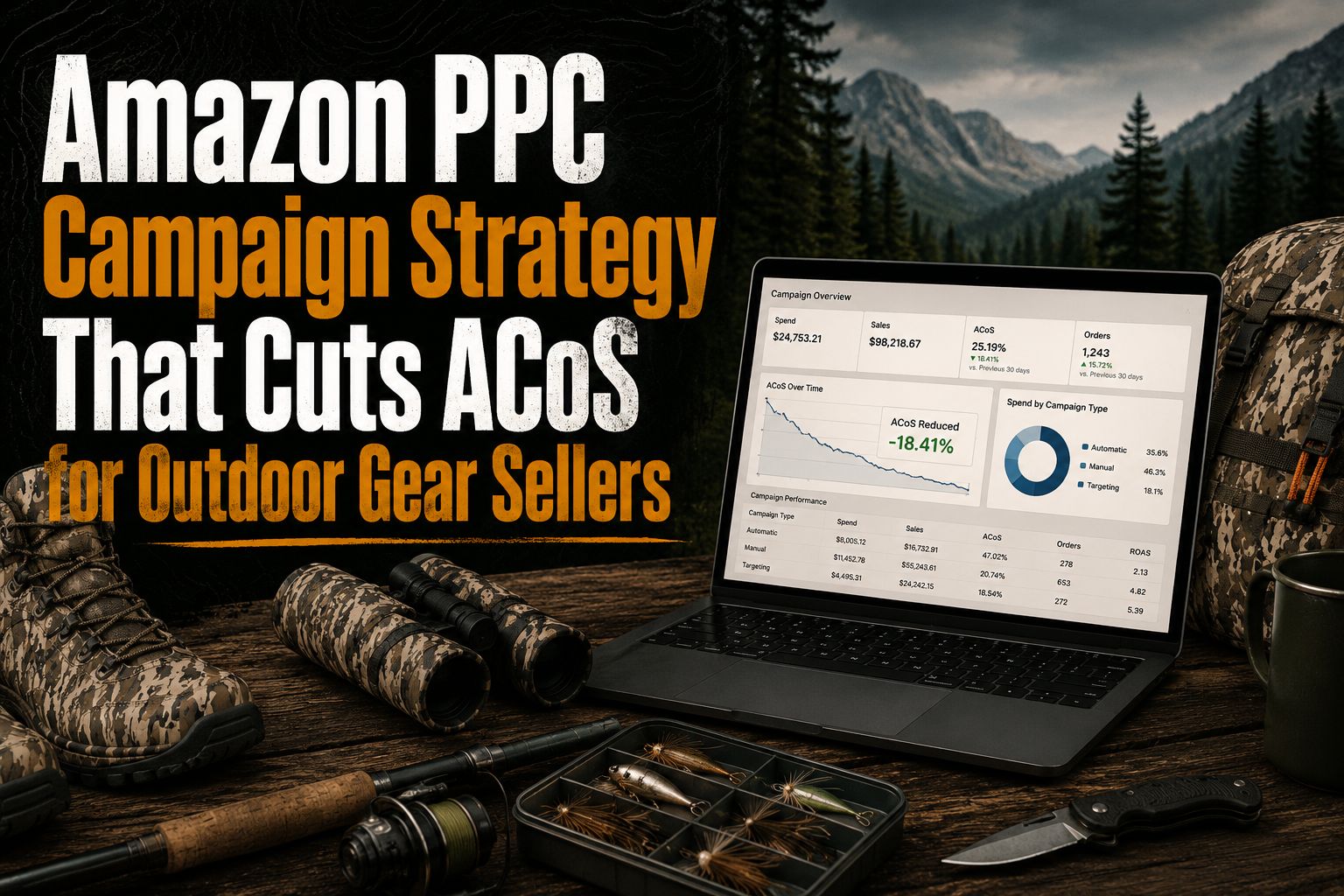
Amazon PPC Campaign Strategy That Cuts ACoS for Outdoor Gear Sellers
High ACoS is not bad luck. It is a structural problem.
Most outdoor gear sellers build campaigns without a real strategy. They run auto campaigns. They set bids randomly. They never review their search term reports. Then they wonder why their ACoS keeps climbing.
The truth is brutal but simple. A high ACoS is always a symptom. The real disease is a lack of amazon ppc campaign strategy.
This guide gives you the exact framework to fix it. You will learn how to build campaigns that lower ACoS month after month. And how a professional amazon ppc optimization service compounds those gains over time.
What ACoS Actually Means and Why Most Sellers Read It Wrong
ACoS stands for Advertising Cost of Sale. It is your ad spend divided by attributed sales. Expressed as a percentage.
If you spent $100 in ads and generated $400 in sales, your ACoS is 25%.
But here is what most outdoor sellers get wrong. They chase the lowest possible ACoS. That sounds logical. It is not always correct.
A low ACoS on a shrinking revenue number is not a win. You are protecting margin while losing market share. Your organic rankings drop. Competitors capture the sales you walked away from.
The goal is not the lowest ACoS. The goal is the right ACoS — one that keeps you profitable while still driving the sales velocity that builds organic rank.
Know your break-even ACoS first. If your product margin is 40%, your break-even ACoS is 40%. Work backwards from there to set your target.
The Campaign Structure That Fixes ACoS at the Root
Structure is everything. A disorganised account generates noisy data. Noisy data leads to bad decisions. Bad decisions raise ACoS.
Separate Every Match Type Into Its Own Campaign
This is the single most important structural decision you will make.
Do not mix broad, phrase, and exact match keywords in the same campaign. When they share a budget and a single set of bids, you cannot see what is actually working.
Broad match campaigns generate discovery. They surface new search terms you had not considered. Phrase match captures mid-intent searches. Exact match targets your highest-converting, most specific keywords.
Each match type needs its own campaign. Its own budget. Its own bids. Only then can your amazon ppc campaign strategy generate the clean data you need to optimise.
The Auto-to-Manual Pipeline Every Outdoor Brand Needs
This is the most powerful system for lowering ACoS over time.
Start with an automatic campaign. Set a moderate daily budget. Let it run for two to three weeks. Amazon will surface the search terms your products actually appear for.
Every week, pull your search term report. Find the terms that generated sales at or below your target ACoS. Move those exact terms into a manual exact match campaign. Add them as negative keywords in your auto campaign so you stop paying for them there.
Repeat this process weekly. Over time your manual campaigns fill with proven, profitable keywords. Your auto campaigns keep finding new opportunities. Your account gets smarter and cheaper every single week.
Product Targeting Campaigns
Do not ignore product targeting. This is where outdoor gear sellers find some of their best ACoS.
Target competitor ASINs where your product has a clear advantage. Better reviews. Lower price. Stronger imagery. If you cannot win the comparison, do not target that ASIN.
Also target your own ASINs. Cross-sell your fishing rods on your tackle box listings. Cross-sell your hunting scent sprays on your camo jacket listings. These campaigns cost almost nothing. They protect your own product pages from competitor ads and increase basket size.
How to Set Bids That Lower ACoS Without Killing Visibility
Bid management is where most outdoor sellers make their biggest mistakes. They either set bids once and forget them. Or they change them constantly based on short-term noise.
Neither approach works.
The Two-Week Rule
Never adjust bids based on less than two weeks of data. Amazon's attribution window is up to 14 days. A sale today may have been influenced by a click from last week.
Adjusting bids before the attribution window closes means you are reacting to incomplete information. You will make the wrong decisions with confidence.
Wait two to three weeks. Then review.
The Bid Adjustment Framework
Once you have enough data, follow this simple framework:
ACoS below your target: Increase bid by 10 to 15%. Capture more volume at a profitable rate.
ACoS above your target: Reduce bid by 10 to 15%. Protect margin while keeping the keyword active.
Clicks with zero sales after 20+ clicks: Reduce bid significantly or pause the keyword entirely.
Zero impressions: Bid is likely too low. Increase by 20% and monitor.
Make one change at a time. Give each change two weeks before adjusting again. This disciplined approach is the core of any serious amazon ppc optimization service.
Negative Keywords: The Fastest Way to Cut ACoS Today
If you do nothing else after reading this guide, do this. Add negative keywords to your campaigns this week.
Every search term that triggered your ad but generated zero sales is wasted spend. Those clicks are real money leaving your account for nothing in return.
Pull your search term report right now. Filter for terms with more than five clicks and zero sales. Add every single one as a negative keyword.
For outdoor gear sellers this is especially impactful. Your hunting gear may appear for searches like "airsoft guns" or "paintball equipment." Your fishing rods may appear for "pool toys" or "water guns." These are completely irrelevant. Every click is pure waste.
Negative Keyword Match Types Matter Too
Use negative exact match for specific irrelevant terms. Use negative phrase match to block entire categories of irrelevant searches.
For example, if you sell premium handmade fishing lures, add "cheap" and "kids" as negative phrase match. You do not want clicks from budget shoppers or parents buying toys.
This targeting precision is what separates a refined amazon ppc campaign strategy from a campaign that just runs.
Dayparting and Budget Strategy for Outdoor Gear Sellers
Outdoor buyers do not shop at the same rate throughout the day. Hunting and fishing shoppers have distinct patterns.
Early morning and evening hours typically drive stronger conversion for outdoor categories. Weekend shopping spikes are common. If your budget runs out by midday you are missing your best converting hours.
How to Manage Budget Pacing
Check your campaign budgets daily during your first month. If campaigns consistently hit their budget cap before the day ends, increase the budget or adjust your bid strategy.
Do not simply increase bids to compensate for low impression share. Understand why impressions are low first. It may be a budget issue. It may be a listing relevancy issue. It may be a keyword issue.
Diagnose before you spend more.
The Role of Listing Quality in Your ACoS
Here is something most outdoor sellers do not want to hear. Your ACoS problem might not be your campaigns. It might be your listing.
Even the most precise amazon ppc optimization service cannot overcome a listing that does not convert.
If your main image does not show the product in use, shoppers bounce. If your title does not match the search intent, your click-through rate suffers. Amazon's algorithm reads low CTR and low conversion as signals to reduce your ad visibility. Your bids rise. Your ACoS rises.
Before blaming your campaigns, audit your listing:
Does the main image show the product in a real outdoor setting?
Is your primary keyword in the first 80 characters of your title?
Do your bullet points lead with benefits, not specifications?
Is your A+ Content complete and visually compelling?
Fix those issues first. The same ad spend on a strong listing will always outperform the same spend on a weak one.
TACoS: The Metric That Tells You If Your Strategy Is Actually Working
ACoS tells you how efficient your ads are. TACoS tells you if your overall business is growing.
TACoS is your total ad spend divided by your total revenue, including organic sales. It is the most important long-term metric for any outdoor brand running Amazon PPC.
When your TACoS declines over time while revenue grows, your PPC investment is working. Your ads are driving sales velocity. That velocity is improving your organic rankings. As organic sales grow, the same ad spend represents a smaller percentage of total revenue.
That is the compound effect every outdoor brand should be building toward. It is the difference between an ad account that drains margin and one that builds a self-sustaining revenue engine.
When to Bring In a Professional Amazon PPC Optimization Service
Self-managing Amazon PPC works at a small scale. Once your ad spend exceeds $3,000 to $5,000 per month, the complexity compounds fast.
More campaigns. More keywords. More products. More data to interpret. More decisions to make every week.
At that stage, the cost of a professional amazon ppc optimization service is almost always lower than the cost of inefficiency in a self-managed account.
The right service does not just manage your bids. It builds a system. It audits your listing quality. It develops a keyword strategy specific to your outdoor category. It tracks the metrics that matter and reports on them clearly every week.
If you want to understand how paid ads fit into a complete growth system for your outdoor brand, visit our full-stack ecommerce growth page. Or read our main guide on Amazon PPC & Paid Ads Management to see the full strategy behind profitable Amazon advertising.
Frequently Asked Questions
What is a good ACoS for outdoor gear sellers on Amazon?
A good ACoS is any number at or below your product margin percentage. If your margin is 35%, your target ACoS should be 35% or lower. New product launches may justify a higher ACoS temporarily to build ranking and reviews.
How quickly can I lower my ACoS with better campaign strategy?
Most outdoor sellers see measurable ACoS improvement within four to six weeks of implementing clean campaign structure and consistent negative keyword management. Significant improvement typically builds over two to three months.
What is the difference between ACoS and TACoS?
ACoS measures ad spend against ad-attributed sales only. TACoS measures ad spend against total revenue including organic sales. TACoS is the more accurate indicator of your overall advertising efficiency and long-term brand health.
How many campaigns should an outdoor gear brand run?
It depends on your product catalogue. At minimum, most brands should run separate auto and manual campaigns per product or product group. A brand with ten products may manage 30 to 50 campaigns across all match types and targeting strategies.
Do I need an amazon ppc optimization service or can I manage it myself?
At lower budgets under $2,000 per month, self-management with a clear framework is achievable. Above $3,000 to $5,000 per month, professional management almost always generates better returns than the cost of the service.


It all starts
with a conversation.
Quick Links
Join Our Newsletter
* Will send you weekly updates for your better tool management.
© 2026 Six Star Brands. Privacy Policy & Terms of Service