
OUR BLOGS
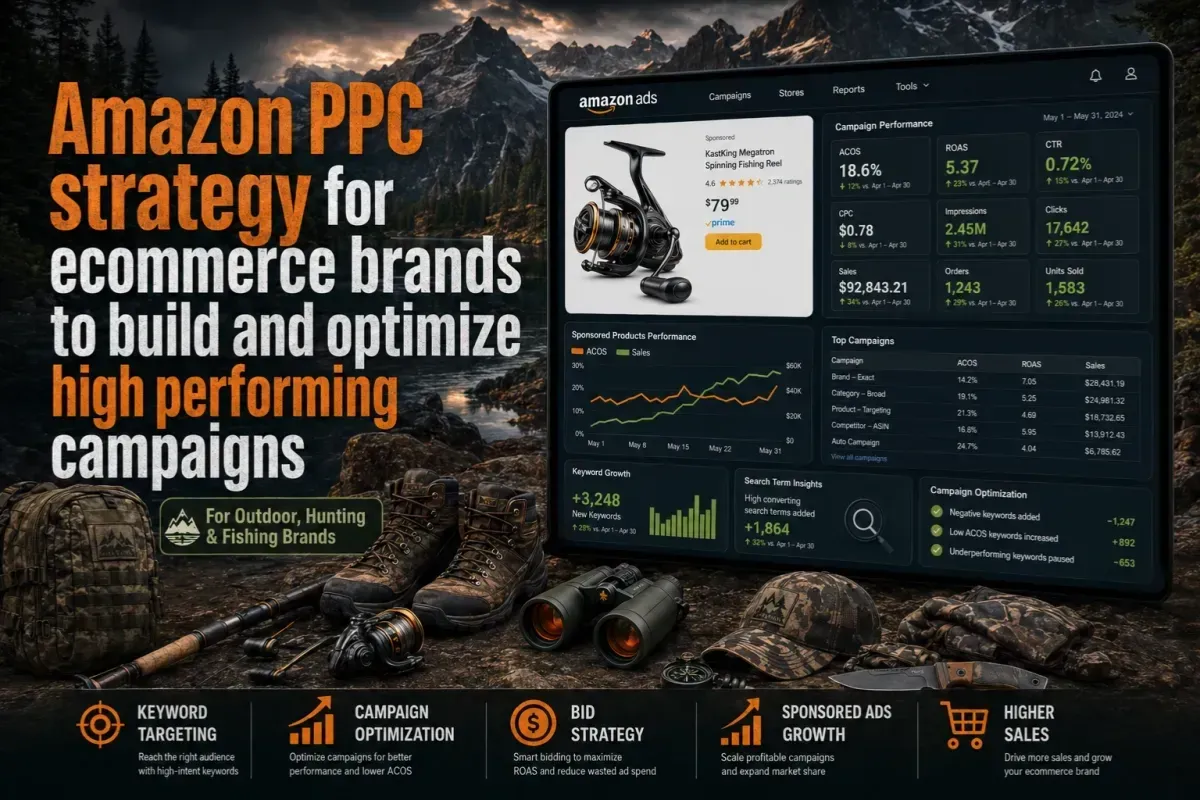
Amazon PPC Strategy for Ecommerce Brands to Build and Optimize High Performing Campaigns
Most ecommerce brands treat Amazon PPC the same way they treat a light switch — turn it on, spend some money, and expect sales to follow. When results disappoint, they either increase the budget hoping more spend will fix the problem, or they turn it off entirely and conclude that Amazon advertising does not work for their brand.
Neither response addresses the real issue. Amazon PPC does not reward spend. It rewards strategy. The brands generating the strongest returns from Amazon advertising are not necessarily spending the most. They are spending the most intelligently, with a clear campaign structure, disciplined bid management, rigorous keyword strategy, and a relentless focus on profitability at every level of their account.
This guide breaks down exactly what a high-performing Amazon PPC strategy looks like in 2026, how to build campaigns that drive profitable growth, and how to optimize them over time so your results compound rather than plateau.
What Amazon PPC Actually Is And What It Is Not
Amazon PPC, or pay-per-click advertising, is the system that allows sellers to bid for prominent placement in Amazon search results and on product detail pages. You pay only when a shopper clicks your ad. The amount you pay per click is determined by your bid relative to competitors bidding on the same keywords or targeting the same products.
There are three main ad types within Amazon's advertising ecosystem, Sponsored Products, Sponsored Brands, and Sponsored Display. Each serves a different purpose, reaches shoppers at different stages of the buying journey, and requires a different strategic approach. Treating all three the same way is one of the most common and costly mistakes sellers make.
What Amazon PPC is not is a set and forget system. The marketplace is dynamic. Competitor bids change daily. New products enter your category. Search trends shift seasonally. A campaign that performs well in January may bleed money by March if nobody is actively managing it. This is why Amazon ads management is not a launch task, it is an ongoing operational discipline.
Key Insight: Amazon PPC is not just an advertising tool. When managed correctly, it is a ranking tool. Sales generated through paid campaigns contribute to your sales velocity, which directly improves your organic search rankings. The long-term value of a well-run PPC strategy extends far beyond the immediate revenue it generates.
The Strategic Foundation - What You Must Get Right Before Launching Any Campaign
Rushing into campaign setup without laying the right foundation is how sellers waste their first three months and thousands of dollars on Amazon PPC. Before a single campaign goes live, three things need to be in place.
Your Listing Must Be Conversion Ready
Paid traffic sent to a weak listing is money thrown away. Your product title, bullet points, images, and A+ Content need to be fully optimized before you start paying for clicks. A listing converting at 15 percent will generate three times the sales from the same ad spend as a listing converting at 5 percent, while cutting your effective advertising cost to a third. No bid strategy or campaign structure can overcome the drag of a poor listing. Fix the listing first.
You Need to Know Your Numbers
Profitable Amazon PPC management starts with understanding your unit economics. You need to know your product cost, Amazon fees, shipping costs, and desired profit margin before you can set meaningful targets for your advertising. From these numbers, you can calculate your break-even ACoS, the maximum advertising cost of sale at which you neither profit nor lose on an advertised sale. Every campaign decision, bids, budgets, keyword targets, should be made in reference to this number.
Your Keyword Research Must Be Done In Advance
Launching campaigns without comprehensive keyword research means you are either targeting the wrong terms from day one, or you are relying entirely on Amazon's automatic targeting to discover your keywords for you. Automatic campaigns are valuable for discovery, but they should supplement a keyword strategy, not replace one. Know your primary keywords, your secondary keywords, and your competitor targets before you build your first campaign.
Campaign Types - Understanding What Each One Does and When to Use It
Sponsored Products — The Core of Any Amazon PPC Strategy
Sponsored Products ads appear within search results and on product detail pages, and they are the highest volume, most direct performance driver in Amazon's ad ecosystem. They target individual product listings and direct shoppers straight to a product page when clicked. For most sellers, Sponsored Products campaigns represent the majority of their ad spend and generate the majority of their attributed revenue.
A strong Sponsored Products strategy separates campaigns by match type and by keyword intent. Exact match campaigns give you precise control over which searches trigger your ads and what you pay for each one. Phrase match campaigns broaden your reach slightly while maintaining relevance. Broad match campaigns cast the widest net, useful for discovery but requiring close management to prevent wasted spend on irrelevant searches.
Sponsored Brands — Building Visibility Beyond the Individual Product
Sponsored Brands ads appear as banner placements at the top of search results, featuring your brand logo, a custom headline, and multiple products. They are available exclusively to brand-registered sellers and serve a fundamentally different strategic purpose than Sponsored Products.
Where Sponsored Products capture shoppers searching for a specific product, Sponsored Brands capture shoppers who are still in category exploration mode, browsing, comparing, and forming preferences. A well-crafted Sponsored Brands campaign positions your brand as the category leader before the shopper has even decided which product they want. Over time, strong Sponsored Brands performance builds branded search volume, shoppers who start searching directly for your brand name rather than a generic product term, which is one of the most valuable and defensible assets an Amazon brand can build.
Sponsored Display — Retargeting and Audience Expansion
Sponsored Display operates differently from Sponsored Products and Sponsored Brands. Rather than targeting search keywords, it targets audiences and product pages, allowing you to reach shoppers who viewed your product but did not purchase, shoppers browsing competitor products, and audiences defined by purchase behavior and interests.
The retargeting capability of Sponsored Display is particularly powerful. A shopper who viewed your listing is already warm, they showed interest but did not convert. Serving them a Sponsored Display ad as they browse other parts of Amazon keeps your product visible and recovers sales that would otherwise be lost. This bottom-of-funnel function makes Sponsored Display a high-efficiency complement to the top-of-funnel reach of Sponsored Products and Sponsored Brands.
Building Your Amazon PPC Campaign Structure
Campaign structure is where most Amazon PPC strategies either succeed or fail at the foundation level. A well structured account gives you clear visibility into what is working, precise control over where your budget goes, and the ability to optimize intelligently. A poorly structured account is a tangle of overlapping targeting, conflicting bids, and data that tells you almost nothing useful.
The Isolation Principle
The most important structural principle in Amazon PPC campaign strategy is isolation, keeping different keyword types, match types, and product targets in separate campaigns or ad groups so that performance data stays clean and actionable. When broad match, phrase match, and exact match keywords all live in the same campaign, you cannot tell which match type is driving your results or costing you money. When high-performing and low-performing products share the same campaign, the losers drain budget from the winners.
Structure your campaigns so that each one answers a specific question. This exact match campaign, is this keyword profitable at this bid? This automatic campaign — what new search terms are shoppers using to find products like mine? This competitor targeting campaign — can I capture market share from shoppers browsing these specific competitor listings?
The Auto to Manual Pipeline
One of the most powerful structural approaches in Amazon PPC is using automatic campaigns as a continuous keyword discovery engine that feeds your manual campaigns. Automatic campaigns let Amazon's algorithm match your ads to search terms it determines are relevant to your product. Some of those matches will be irrelevant or unprofitable. But some will be high-converting search terms you never would have found through keyword research alone.
The system works like this. Run automatic campaigns with a moderate bid and a defined budget. Review your search term reports weekly. Identify search terms generating sales at or below your target ACoS. Move those terms into dedicated exact match manual campaigns with optimized bids. Add them as negative keywords in your automatic campaigns to prevent double-spending. Repeat continuously.
Over time, this pipeline fills your manual campaigns with battle-tested, conversion-proven keywords, making your entire account progressively more efficient and profitable.
Negative Keywords — The Most Underused Optimization Lever
Negative keywords prevent your ads from appearing for searches that are irrelevant to your product. They are the single most powerful tool for eliminating wasted spend in any Amazon PPC account, and they are systematically underused by most sellers.
Every week, your search term reports will reveal searches that triggered your ads but generated zero sales, irrelevant searches, competitor brand searches you cannot win, or searches indicating buyer intent that does not match your product. Adding these as negative keywords immediately stops you from paying for those clicks going forward. The budget freed up flows into your profitable keywords, improving overall account efficiency without spending an additional dollar.
Bid Strategy — How to Set and Adjust Bids for Maximum Profitability
Bidding is where the art and science of Amazon ads management converge. Set bids too low and your ads rarely win placements, limiting your visibility and sales velocity. Set bids too high and you win placements that cost more than the sales they generate are worth. Finding the right bid for each keyword is an ongoing calibration process, not a one-time setup task.
Start With Data Driven Default Bids
When launching a new campaign, you rarely have direct data on what a winning bid looks like for your specific product and keywords. Amazon's suggested bid ranges give you a starting reference point, but treat them as a starting point only, not a target. Begin at the lower end of the suggested range for discovery campaigns and at a competitive level for your known high-priority keywords. Let the campaigns run for one to two weeks before drawing conclusions from the data.
Optimize Bids Based on Performance, Not Intuition
Once your campaigns have accumulated meaningful data, a minimum of two to three weeks at consistent spend, start making bid adjustments based on actual performance metrics. Keywords generating sales below your target ACoS can support higher bids to capture more volume. Keywords generating sales above your target ACoS need bid reductions to bring them back into profitability. Keywords generating clicks but zero sales over a meaningful sample size need either a bid reduction to reduce exposure or a negative keyword designation to stop spending on them entirely.
Make bid changes incrementally, 10 to 20 percent adjustments rather than dramatic swings. Dramatic bid changes destabilize performance data and make it harder to understand what is actually driving results. Patience and consistency in bid management compound into significant efficiency gains over months.
Placement Bid Adjustments
Amazon allows you to adjust bids by placement, top of search, rest of search, and product pages. Top of search placements typically generate the highest conversion rates but are also the most expensive. Product page placements are cheaper but convert differently. Review your placement performance data regularly and use these adjustments to concentrate your budget on the placements generating the strongest return for your specific products.
Keyword Strategy — Going Beyond the Obvious Terms
Most sellers target the obvious, high-volume keywords in their category and then wonder why their campaigns are expensive and competitive. A sophisticated Amazon PPC campaign strategy goes deeper, finding the keyword opportunities that drive profitable sales volume without the brutal competition of the most obvious terms.
Long-Tail Keywords Are Where Profitability Lives
Long tail keywords, search terms with three or more words that describe a specific product, use case, or customer need, consistently outperform broad, high-volume keywords on the metrics that matter most: conversion rate and ACoS. A shopper searching for "waterproof hiking boots for wide feet size 11" is further along in their purchase decision than a shopper searching for "hiking boots." They know exactly what they want. When your product matches that specific intent, conversion rates are high and competition for that exact term is lower.
Build your keyword strategy around a core of competitive primary keywords supported by a large volume of long-tail terms. The primary keywords drive volume and visibility. The long-tail terms drive efficiency and profitability. Together they create a campaign portfolio that scales without losing margin.
Competitor Targeting — A Misunderstood Opportunity
Targeting competitor ASINs and keywords is one of the most direct ways to capture market share on Amazon, but most sellers either avoid it entirely or execute it poorly. The goal of competitor targeting is not to show up everywhere a competitor appears — it is to intercept shoppers who are considering a competitor product and present your product as a compelling alternative at the moment they are most open to switching.
This works best when your product has a clear, demonstrable advantage over the competitor you are targeting, better reviews, a lower price, a superior feature, or a stronger brand presentation. If your listing cannot make a compelling case to a shopper who was already interested in a competitor product, competitor targeting will generate clicks without conversions and drain your budget quickly.
Amazon Ads Management — What Ongoing Optimization Actually Looks Like
Launching well-structured campaigns with a smart keyword strategy is only the beginning. The difference between Amazon PPC accounts that deliver improving returns over time and accounts that plateau or deteriorate is the quality of ongoing management.
Weekly Tasks That Keep Campaigns Healthy
Every week, a well managed Amazon PPC account should include search term report review and negative keyword additions, bid adjustments on keywords with sufficient performance data, budget pacing checks to ensure campaigns are not running out of budget during peak shopping hours, and campaign health checks to identify any listings with suppressed visibility or policy issues that could affect ad delivery.
These weekly tasks do not take long when done consistently. Skipping them for two or three weeks allows waste to accumulate, budgets to misallocate, and performance to drift in the wrong direction. Consistency in management is what separates accounts that improve month over month from accounts that stagnate.
Monthly Analysis — Seeing the Bigger Picture
Monthly analysis goes beyond the tactical adjustments of weekly management. It is where you evaluate overall account performance trends, assess whether your campaign structure is still serving your business goals, identify your highest and lowest performing products for budget reallocation, and plan strategic changes for the coming month based on seasonal trends, new product launches, or competitive shifts.
Monthly analysis should also include a review of your TACoS, total advertising cost of sale — which measures your ad spend against total revenue including organic sales. TACoS is a more meaningful long-term health metric than ACoS alone because it captures the relationship between your paid performance and your organic growth. A declining TACoS over time, even as absolute ad spend grows, indicates that your PPC investment is successfully building organic ranking momentum.
Related Read: Amazon PPC does not operate in isolation. To understand how it fits into a complete strategy that includes listing optimization, funnels, and retention marketing, read our guide on ecommerce growth strategy using ads, funnels, Amazon and retention, the full-stack framework we use to scale ecommerce brands profitably at Six Star Brands.
Common Amazon PPC Mistakes That Kill Campaign Performance
Treating PPC as a set-and-forget system:
Campaigns that are not actively managed deteriorate. The marketplace changes constantly. Your campaigns need to change with it.
Running only automatic campaigns:
Automatic campaigns are discovery tools. Building your entire strategy around them means you have no control over what you are bidding on or what you are paying. Manual campaigns built from keyword research and auto campaign data are where your performance foundation lives.
Ignoring search term reports:
Your search term reports are the most valuable data in your entire PPC account. They show you exactly what shoppers typed before clicking your ad. Not reviewing them weekly means you are funding irrelevant clicks indefinitely.
Setting and forgetting bids:
Bids that made sense three months ago may be significantly over or under market today. The competitive landscape shifts constantly. Regular bid optimization is not optional — it is the primary lever for improving account efficiency over time.
Optimizing for ACoS alone:
ACoS measures ad efficiency on attributed sales. It does not measure the full profitability impact of your campaigns including organic ranking improvements driven by paid sales velocity. Brands that optimize purely for the lowest possible ACoS often underinvest in PPC and leave significant organic growth on the table as a result.
Launching ads without an optimized listing:
Paying for traffic that lands on a weak listing is the most direct way to waste PPC budget. Listing optimization and PPC strategy must work together — one without the other produces a fraction of the results both together can generate.
Frequently Asked Questions
What is Amazon PPC strategy?
Amazon PPC strategy is the structured approach to planning, building, and optimizing pay-per-click advertising campaigns on Amazon. It covers campaign type selection, keyword research, match type management, bid strategy, negative keyword implementation, and ongoing performance optimization, all aligned to the goal of driving profitable sales while building organic ranking momentum over time.
What is Amazon PPC campaign strategy?
Amazon PPC campaign strategy refers specifically to how individual campaigns are structured and managed within an overall Amazon advertising approach. It includes decisions about campaign type, targeting method, keyword organization, budget allocation, and bid management, designed to maximize return on ad spend while maintaining clear visibility into what is driving results at every level of the account.
How much should I spend on Amazon PPC?
There is no universal answer. Your Amazon PPC budget should be determined by your product margins, your target ACoS, and the competitive intensity of your category. A common starting point for new products is $20 to $50 per day per campaign during the learning phase. As performance data accumulates and campaigns are optimized, budgets can be scaled up on campaigns demonstrating consistent profitability.
What is a good ACoS for Amazon PPC?
A good ACoS depends entirely on your product margins. Your target ACoS should be equal to or below your profit margin percentage. If your product has a 35 percent margin, you want your ACoS at or below 35 percent to remain profitable. Many established brands with strong organic rankings run PPC at an ACoS above their margin deliberately, knowing the sales velocity generated is building organic ranking value that more than compensates for the short-term ad cost.
What is the difference between ACoS and TACoS?
ACoS measures your ad spend as a percentage of revenue directly attributed to ads. TACoS measures your ad spend as a percentage of your total revenue including organic sales. TACoS is the more meaningful long term health metric because it captures how effectively your PPC investment is building organic growth. A declining TACoS over time indicates your paid campaigns are successfully driving organic ranking improvements.
What does Amazon ads management involve?
Amazon ads management involves the ongoing monitoring, optimization, and strategic development of an Amazon PPC account. It includes weekly search term report reviews, bid adjustments, negative keyword additions, budget management, campaign structure refinements, and monthly performance analysis. Effective Amazon ads management is an active, continuous discipline, not a one-time setup task.
Final Thoughts
Amazon PPC is one of the most powerful and measurable growth tools available to ecommerce brands, but only when approached with the right strategy, structure, and discipline. The brands that win on Amazon are not the ones spending the most on ads. They are the ones spending the most intelligently, with campaigns built on solid foundations, managed with consistency, and optimized with a long-term view of profitability.



It all starts
with a conversation.
Quick Links
Join Our Newsletter
* Will send you weekly updates for your better tool management.
© 2026 Six Star Brands. Privacy Policy & Terms of Service