
OUR BLOGS
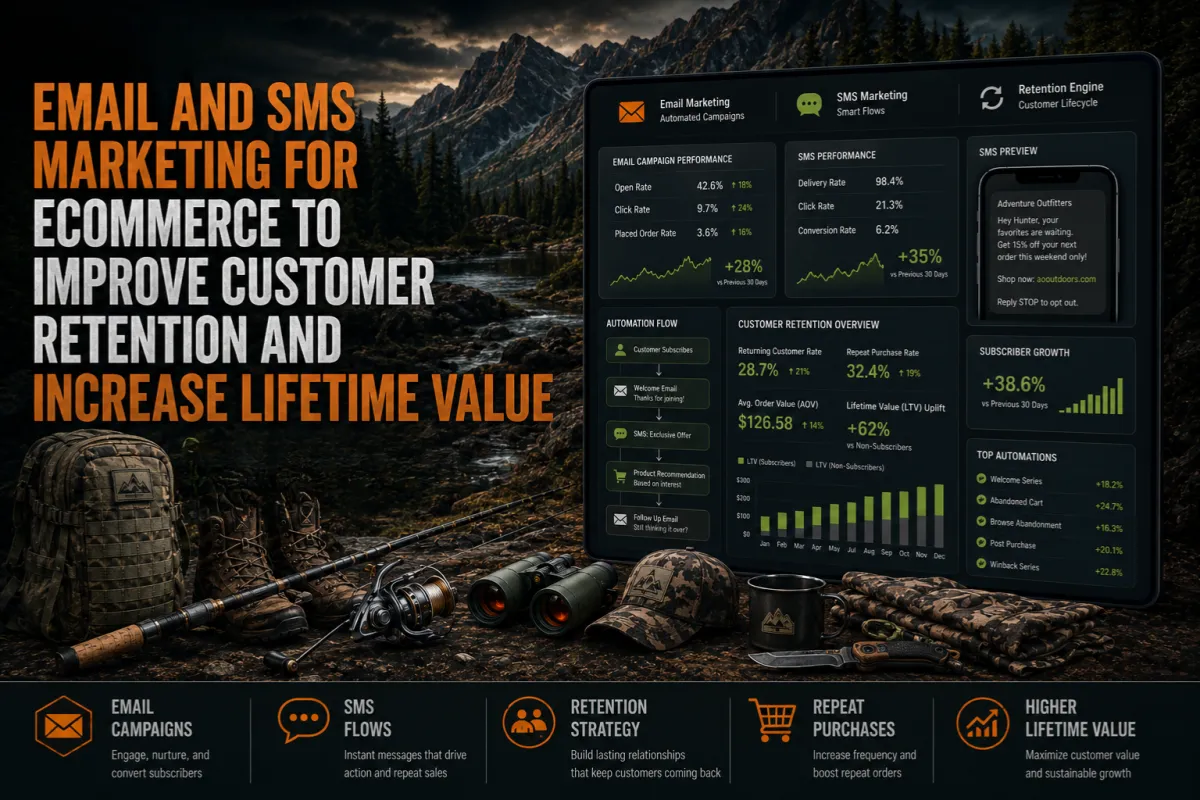
Email & SMS Marketing to Boost Ecommerce Retention
Every ecommerce brand obsesses over acquisition. New customers, new traffic, new ad campaigns. The marketing calendar revolves around bringing in people who have never heard of the brand before. And while acquisition matters, it is only half of the growth equation — and arguably the more expensive half.
The brands that build lasting, compounding revenue are not necessarily the ones acquiring the most customers. They are the ones keeping them. A customer who buys once and disappears has a lifetime value of a single transaction. A customer who buys three, four, or five times over the course of a year is worth multiples of that — and costs nothing to acquire on the second, third, or fourth purchase.
This is where ecommerce email marketing and SMS marketing services become the most profitable channels in your entire marketing stack. Not because they are flashy or cutting-edge, but because they reach customers who already know your brand, already trust your products, and already have a reason to buy again — if you give them the right message at the right moment.
Why Customer Retention Is the Most Undervalued Growth Lever in Ecommerce
There is a widely cited statistic in ecommerce that acquiring a new customer costs five times more than retaining an existing one. Whether the exact multiplier is five or three or seven depends on the brand and the category — but the directional truth is consistent across virtually every ecommerce business. Retention is dramatically more cost-efficient than acquisition.
Yet most ecommerce brands allocate the vast majority of their marketing budget to paid acquisition channels and invest almost nothing in the systems that convert first-time buyers into loyal, repeat customers. The result is a business that works extraordinarily hard to fill a leaking bucket — constantly spending to bring in new customers while existing customers quietly disappear to competitors.
Customer retention marketing through email and SMS is how you stop the leak. It is how you extract the full value from every customer your acquisition efforts bring in. And in an environment where paid traffic costs continue to rise and competition for new customer attention intensifies every year, the brands with strong retention systems have a structural profitability advantage that compounds over time.
Understanding Customer Lifetime Value and Why It Changes Everything
Customer lifetime value — the total revenue a customer generates across all of their purchases with your brand — is the single most important metric for understanding the long-term health and scalability of an ecommerce business. Yet most ecommerce brands either do not track it or do not build their marketing strategy around it.
When you know your average customer lifetime value, everything changes. You know how much you can afford to spend acquiring a customer and still build a profitable business. You know which customer segments are worth investing in most heavily for retention. You know how much revenue improvement is possible if you can move your average customer from purchasing once to purchasing twice — or from twice to three times.
Email marketing for ecommerce and SMS marketing services are the primary tools for improving lifetime value because they are the channels through which you maintain a direct, ongoing relationship with your existing customers. Social media algorithms limit your organic reach. Paid ads reach people who may or may not be your customers. Email and SMS reach people who have explicitly given you permission to contact them — and who have already demonstrated, through a purchase, that they value what you offer.
Ecommerce Email Marketing — Building the Retention Engine
Email remains the highest-ROI marketing channel available to ecommerce brands. Not because it is the newest or most exciting, but because it is direct, personal, measurable, and owned. Unlike paid platforms where your reach depends on your budget, or social platforms where your reach depends on an algorithm, your email list is an asset you control completely. No platform can take it away, suppress it, or charge you more to reach it.
But the way most ecommerce brands use email marketing leaves enormous revenue on the table. They send promotional blasts when they have a sale. They email their list on holidays. They occasionally announce a new product. And in between, they go quiet — letting the relationship with their customer go cold until the next promotion.
This is not email marketing. It is email broadcasting. And it generates a fraction of the revenue that a properly structured ecommerce email marketing system produces.
The Flows That Generate Revenue While You Sleep
The foundation of a high-performing ecommerce email marketing strategy is automated flows — sequences of emails triggered by specific customer behaviors that deliver the right message at the right moment without any manual effort after the initial setup.
The Welcome Flow is the most important sequence in your entire email program. It is triggered when someone subscribes to your list — often before they have made a first purchase. The welcome flow introduces your brand, communicates your values and story, showcases your best products, and gives the subscriber a compelling reason to make their first purchase. A well-built welcome flow converts subscribers into first-time buyers at a rate that no promotional campaign can match — because it reaches people at the moment of peak brand curiosity.
The Abandoned Cart Flow targets shoppers who added products to their cart but did not complete the purchase. These are your warmest potential customers — they demonstrated clear purchase intent and stopped one step short of converting. A well-timed abandoned cart sequence, typically three emails sent over 24 to 48 hours, recovers a significant percentage of these almost-sales. The first email is a simple, friendly reminder. The second reinforces the value of the product and addresses common objections. The third may introduce a time-limited incentive for the most hesitant shoppers.
The Post-Purchase Flow begins immediately after a customer completes their first order and is the most important retention tool in your email arsenal. Its job is to turn a transactional relationship into an ongoing one. It sets expectations for delivery, expresses genuine appreciation, introduces the customer to related products or complementary items, shares content that helps them get more value from what they just bought, and at the right moment — typically after delivery — invites a review. A strong post-purchase flow plants the seeds of the second purchase before the first one has even arrived.
The Winback Flow targets customers who have not purchased in a defined period — typically 60 to 120 days depending on your average purchase frequency. It re-engages lapsed customers with personalized messaging that acknowledges the time gap, reminds them of what they loved about your brand, and presents a compelling reason to return. Winback flows consistently generate revenue from a customer segment that most brands have effectively written off — and they do it at near-zero incremental cost.
The Browse Abandonment Flow is triggered when a customer or subscriber views a product page but does not add to cart. It is a lighter touch than abandoned cart — because the shopper has not expressed the same level of purchase intent — but it keeps your product visible in the consideration window of a shopper who was interested enough to look.
Campaign Emails — How to Message Your List Without Burning It
Automated flows handle the behavioral triggers. Campaign emails handle the ongoing relationship with your full list — announcements, promotions, content, and brand storytelling that keep your customers engaged between purchases.
The mistake most ecommerce brands make with campaign emails is treating every send as a promotional opportunity. When every email your subscribers receive is a discount or a sale announcement, two things happen. Open rates decline as subscribers learn that your emails are purely transactional. And your brand trains its customers to only buy when there is a promotion — eroding full-price sales and compressing margins.
The most effective ecommerce email marketing programs mix promotional emails with value-adding content. Emails that share how to get more from a product the customer already owns. Emails that tell the brand story or introduce the people behind the products. Emails that share relevant content, tips, or insights related to the lifestyle your brand serves. These non-promotional emails build the relationship that makes your promotional emails more effective — because they are received by a subscriber who genuinely looks forward to hearing from you.
Segmentation — Why Sending the Same Email to Everyone Is Leaving Revenue Behind
The era of batch-and-blast email marketing is over for any brand serious about performance. Sending the same email to every subscriber on your list — regardless of what they have bought, how recently they purchased, how engaged they are, or what products they have shown interest in — produces mediocre results across the board.
Segmentation is the practice of dividing your email list into groups based on shared characteristics and sending each group messaging that is specifically relevant to them. Customers who bought Product A three months ago should receive different messaging than customers who bought Product B last week, who should receive different messaging than subscribers who have never purchased at all.
Even basic segmentation — separating active customers from lapsed customers, or high-value customers from one-time buyers — produces measurable improvements in open rates, click rates, and revenue per email. Advanced segmentation based on purchase history, product category affinity, and predicted next purchase timing takes those improvements significantly further.
SMS Marketing Services — The Channel With the Highest Open Rates in Marketing
If email is the foundation of ecommerce retention marketing, SMS is the accelerant. Text messages are opened at rates that no other marketing channel approaches — consistently above 95 percent, with the majority read within minutes of receipt. For time-sensitive communications, high-urgency promotions, and direct customer touchpoints, SMS marketing services deliver reach and immediacy that email simply cannot match.
But with that immediacy comes a responsibility that many brands underestimate. SMS is a deeply personal channel. Subscribers are giving you access to the same inbox where they receive messages from family and friends. Abuse that trust — through excessive frequency, irrelevant content, or purely promotional messaging — and you will see opt-out rates that damage your list and your brand. Respect it, and SMS becomes one of the most powerful revenue-generating and relationship-building tools in your marketing stack.
What SMS Marketing Does Better Than Email
SMS excels in specific scenarios where speed, brevity, and immediacy matter more than depth and design. Flash sales and limited-time offers perform exceptionally well via SMS — the urgency of a time-limited promotion is amplified by the immediacy of a text message that arrives in seconds and is read within minutes. Back-in-stock notifications sent via SMS capture demand at the exact moment it is most acute. Shipping and delivery updates via SMS reduce customer service inquiries and improve post-purchase satisfaction. And abandoned cart SMS messages, sent as a complement to email sequences, recover sales from shoppers who may have missed the email or prefer text communication.
Building an SMS List the Right Way
The quality of your SMS list is determined by how you build it. SMS subscribers acquired through high-value opt-in incentives — a meaningful discount, early access to new products, or exclusive SMS-only offers — tend to be highly engaged and long-term subscribers. Subscribers added through deceptive or unclear opt-in processes tend to opt out quickly and generate spam complaints that can damage your SMS deliverability.
Compliance is non-negotiable in SMS marketing. Every subscriber must provide explicit consent to receive marketing messages. Every message must include a clear opt-out mechanism. Regulations governing SMS marketing — including TCPA in the United States and GDPR in Europe — carry significant penalties for non-compliance. Work with reputable SMS marketing services that handle compliance infrastructure and stay current with regulatory requirements.
Integrating SMS and Email Into a Single Retention System
The most sophisticated ecommerce retention marketing programs do not treat email and SMS as separate channels managed independently. They treat them as complementary tools within a single customer communication system — each one deployed based on the type of message, the urgency of the communication, and the preferences of the individual customer.
A customer who opens every email promptly is best reached through email for most communications, with SMS reserved for the highest-urgency moments. A customer who rarely opens email but responds to texts is a candidate for SMS-first sequencing. An abandoned cart sequence might start with an email, follow with an SMS if no purchase occurs within a few hours, and send a final email the following day. Post-purchase sequences might use email for detailed content and SMS for brief, friendly delivery updates.
This orchestrated approach maximizes the reach and effectiveness of both channels without overwhelming subscribers — delivering the right message through the right channel at the right moment.
The Data That Drives Retention Marketing Performance
Retention marketing without data is guesswork. The brands generating the strongest results from email marketing for ecommerce and SMS marketing services are using customer data to make every communication more relevant, more timely, and more personalized.
The Metrics That Actually Matter
Open rate and click rate are the metrics most brands track — and while they are useful directional indicators, they are not the metrics that determine whether your retention marketing is actually driving business results. The metrics that matter are revenue per recipient, revenue per flow, customer purchase frequency, average order value among repeat buyers, and the overall improvement in customer lifetime value over time.
These metrics connect your email and SMS performance directly to business outcomes — not just engagement statistics. A welcome flow with a modest open rate but a strong first-purchase conversion rate is more valuable than a flow with high open rates that rarely generates a sale. Track the metrics that reflect actual revenue impact, not just inbox behavior.
Personalization Beyond First Name
Most ecommerce brands think personalization means putting the customer's first name in the subject line. That is the floor of personalization, not the ceiling. True personalization in ecommerce retention marketing means using purchase history to recommend genuinely relevant products. It means acknowledging the specific product a customer bought and building on that context in subsequent communications. It means recognizing customer milestones — a first anniversary with the brand, a fifth purchase, a loyalty tier achievement — and marking them with something meaningful.
The technology to do this is available through platforms like Klaviyo, which integrates deeply with ecommerce platforms and enables sophisticated behavioral segmentation and dynamic content that makes every email feel like it was written specifically for the person receiving it. The brands that invest in building this level of personalization into their retention programs see measurably stronger engagement, higher repeat purchase rates, and significantly higher customer lifetime value than those treating their list as a homogeneous audience.
Retention Marketing as a Competitive Moat
There is a strategic dimension to customer retention marketing that goes beyond the immediate revenue it generates. A brand with a strong retention system — high repeat purchase rates, strong customer lifetime value, low churn — has a structural competitive advantage that is very difficult for competitors to replicate quickly.
When your customers buy from you repeatedly, your allowable customer acquisition cost rises. You can afford to spend more to acquire a new customer than a competitor with poor retention — because you know that customer will be worth more over their lifetime. This lets you outbid competitors in paid advertising, offer stronger acquisition incentives, and grow faster without sacrificing margins.
Related Read: To see how email and SMS retention fits into a complete ecommerce growth system alongside paid ads, Amazon, and funnel strategy, read our guide on building a full-stack profitable ecommerce brand — the framework we use to scale ecommerce brands from first purchase to long-term profitability at Six Star Brands.
Strong retention also builds the review volume, user-generated content, and word-of-mouth referrals that reduce your dependence on paid acquisition over time. Happy repeat customers leave reviews. They share products with friends. They become the organic growth engine that the best ecommerce brands rely on as they scale.
Common Retention Marketing Mistakes Ecommerce Brands Make
Treating retention as an afterthought:
Most brands build their acquisition systems first and add retention as an afterthought when growth stalls. The brands that build retention systems from day one compound their advantages much faster.
Emailing too frequently without adding value:
Frequency without value trains subscribers to ignore you or opt out. Every email should earn its place in the subscriber's inbox with something genuinely useful, interesting, or relevant.
Ignoring list hygiene:
An email list full of unengaged subscribers harms your deliverability — causing even your best emails to land in spam folders for engaged subscribers. Regular list cleaning, removing subscribers who have not opened in 90 to 180 days after a re-engagement attempt, keeps your deliverability strong and your metrics accurate.
Using SMS as a broadcast channel:
Brands that send the same promotional SMS to their entire list every week see rapid opt-out growth. SMS requires more restraint and more relevance than email — reserve it for high-value, high-relevance communications.
Not connecting retention data to acquisition strategy:
Your retention data tells you who your best customers are, what they buy, and what they have in common. This information is invaluable for building lookalike audiences in paid advertising — letting you acquire more customers who look like your highest-value existing ones.
Measuring opens instead of revenue:
Email and SMS programs optimized purely for open rates often sacrifice the revenue metrics that actually matter. Build your reporting around business outcomes — repeat purchase rate, revenue per subscriber, and lifetime value improvement — and let those guide your optimization decisions.
Final Thoughts
The ecommerce brands that win long term are not necessarily the ones with the biggest acquisition budgets or the most aggressive paid strategies. They are the ones that understand a simple truth — the most valuable customer is the one you already have.
Ecommerce email marketing and SMS marketing services are not supplementary channels to consider once your paid ads are running well. They are foundational growth infrastructure that every ecommerce brand should build as early as possible, because the compounding value of a loyal, retained customer base is the most durable competitive advantage available in this industry.



It all starts
with a conversation.
Quick Links
© 2026 Six Star Brands. Privacy Policy & Terms of Service