
OUR BLOGS
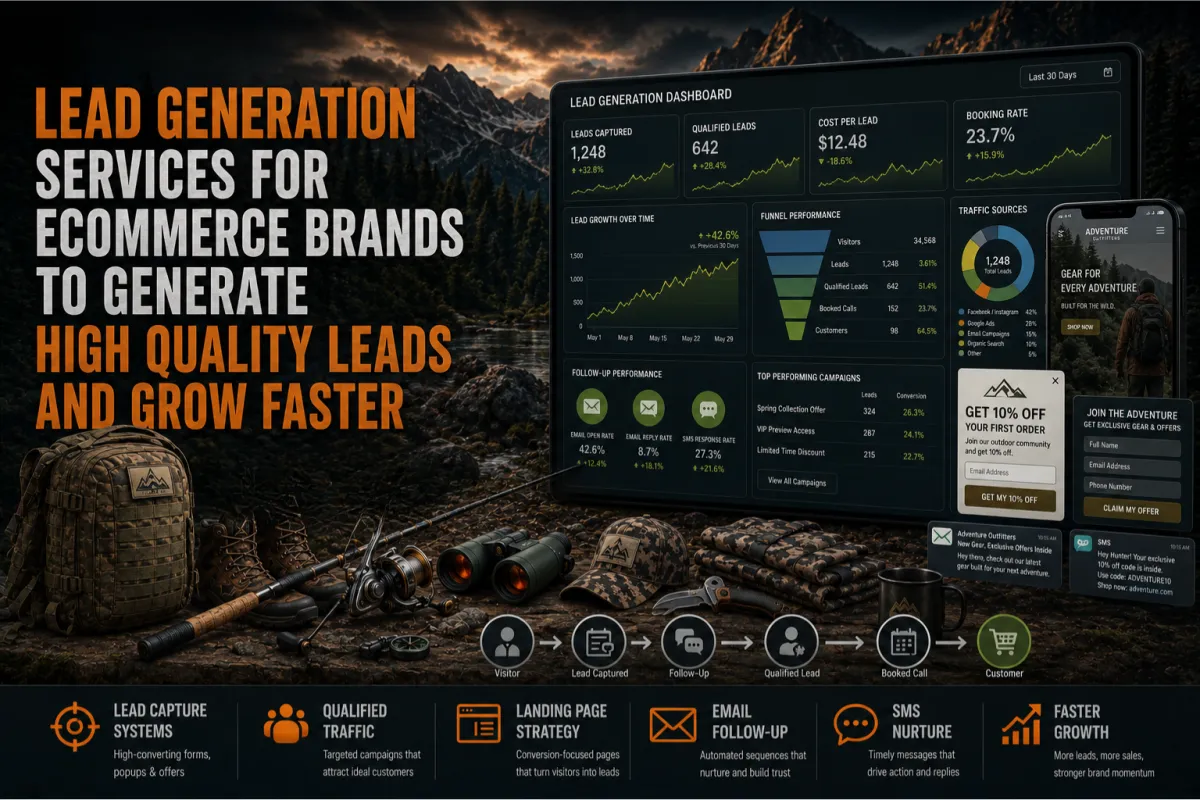
Lead Generation Services for Ecommerce Brands to Generate High Quality Leads and Grow Faster
Most ecommerce brands think about lead generation as something other types of businesses do. Agencies generate leads. Law firms generate leads. Real estate companies generate leads. Ecommerce brands just run ads and hope people buy.
This thinking is costing ecommerce brands an enormous amount of growth.
Lead generation is not a channel reserved for service businesses. It is a strategic approach to building a pipeline of potential customers — people who have expressed genuine interest in what you sell — before asking them to make a purchase decision. And for ecommerce brands operating in competitive categories with rising acquisition costs and shrinking attention spans, building that pipeline is increasingly the difference between brands that scale sustainably and brands that stagnate.
This guide breaks down exactly what lead generation services mean for ecommerce brands, how GHL lead generation systems work in practice, what it takes to generate leads for local business and ecommerce simultaneously, and how to build a lead generation engine that fills your funnel with high-quality prospects ready to convert.
Why Ecommerce Brands Need Lead Generation And Why Most Are Missing It
The traditional ecommerce model goes like this. Run an ad. Drive traffic to a product page. Hope the visitor buys on the first visit. If they do not, retarget them with more ads and hope they eventually convert. This model is increasingly expensive and increasingly fragile.
The problem is that the vast majority of first-time visitors to any ecommerce store are not ready to buy on their first visit. Studies consistently show that fewer than three percent of ecommerce visitors convert on their first session. That means more than 97 percent of the traffic you are paying for leaves without purchasing — and without leaving any way for you to follow up.
If you have no lead generation system in place, those visitors are gone forever. You paid to bring them in, they browsed without buying, and you have no mechanism to continue the conversation. Every one of those non-converting sessions is a sunk cost.
Lead generation changes this equation entirely. By capturing contact information — an email address, a phone number, or both — before a purchase occurs, you transform anonymous traffic into an identifiable, contactable audience of potential customers. You create the ability to nurture that audience over time, build trust, address objections, and deliver the right offer at the moment they are ready to buy. The session that did not convert today becomes the sale that closes next week — or next month — at no additional acquisition cost.
What Lead Generation Services Actually Include
Lead generation services is a broad term that covers a range of strategic and tactical activities designed to attract, capture, and qualify potential customers. For ecommerce brands, a full-service lead generation approach typically spans several interconnected disciplines.
Lead Magnet Strategy and Creation
A lead magnet is the offer that gives a potential customer a compelling reason to share their contact information with your brand. For ecommerce brands, this goes far beyond the generic ten-percent-off popup that every store uses and that shoppers have largely learned to ignore.
Effective lead magnets for ecommerce are genuinely valuable — they give the potential customer something useful, interesting, or exclusive in exchange for their contact details. A buying guide for a high-consideration product category. A quiz that helps shoppers identify the right product for their specific situation. Exclusive access to new product launches before the general public. A free sample or trial offer. A challenge, a mini-course, or a resource bundle related to the lifestyle your brand serves.
The quality of your lead magnet determines the quality of your leads. A weak lead magnet — one that offers minimal value or is clearly just a pretext for capturing an email — attracts low-quality leads who will not engage with your follow-up and will not convert into buyers. A strong lead magnet attracts prospects who are genuinely interested in your brand and what you sell, making every subsequent communication more likely to result in a purchase.
Landing Page Optimization for Lead Capture
A lead generation landing page has one job — converting visitors into leads by getting them to complete the opt-in form. Everything on that page should serve that single objective. The headline should communicate the specific value of the lead magnet clearly and compellingly. The copy should speak directly to the prospect's situation and desire. The form should ask for the minimum information needed, typically just a name and email, or name and phone number for SMS because every additional field reduces completion rates.
The design should be clean, focused, and free of distractions. No navigation links that give visitors a reason to leave before completing the form. No competing offers or promotional banners that divide attention. A single, clear call to action that tells the visitor exactly what they will receive when they submit the form.
Trust signals matter enormously on lead capture pages. A privacy statement that reassures prospects their information will not be shared or spammed. Social proof in the form of testimonials or subscriber counts if relevant. Brand credibility signals, press mentions, certifications, review scores, that establish the legitimacy of the brand asking for their contact details.
Traffic Strategy for Lead Generation
A high-converting lead generation landing page generates zero leads without traffic. The traffic strategy for lead generation differs from direct-to-purchase ecommerce advertising in important ways. You are not asking for a purchase decision, you are asking for a much smaller commitment and this changes both the audience targeting and the creative approach that works best.
Cold audiences who have never heard of your brand can be effectively converted into leads through paid social advertising, particularly on Meta platforms where interest and behavioral targeting allows you to reach people who fit your ideal customer profile before they have ever searched for your product. The lower barrier of a lead opt-in versus a purchase makes it possible to generate leads profitably from cold traffic that would never convert directly to a sale on first contact.
Search advertising through Google captures prospects who are actively searching for solutions related to your product category, high intent traffic that converts into leads at strong rates when matched to a relevant, well-optimized lead capture page. Content marketing and SEO generate organic lead traffic over time by attracting prospects researching topics related to your product category through search engines.
GHL Lead Generation — Building Your System on a Platform Built for Scale
GHL — GoHighLevel — has emerged as one of the most powerful platforms for building and managing lead generation systems for ecommerce brands and local businesses. It is an all-in-one marketing and CRM platform that combines landing page building, email and SMS automation, pipeline management, appointment scheduling, and lead tracking into a single integrated system.
For ecommerce brands serious about building a professional lead generation infrastructure, GHL lead generation offers capabilities that fragmented point solutions — separate tools for landing pages, email, SMS, and CRM — cannot match in terms of integration, automation depth, and operational efficiency.
What Makes GHL Lead Generation Different
The core advantage of GHL for lead generation is the depth and flexibility of its automation capabilities. When a lead enters your system — through a form submission, an ad click, a text message, or any other trigger — GHL can immediately initiate a precisely sequenced, multi-channel nurture workflow that responds dynamically to how the lead behaves.
A prospect who submits a quiz lead magnet receives an immediate email with their personalized results and a product recommendation tailored to their quiz responses. If they click the product link but do not purchase within 24 hours, an automated SMS follow-up re-engages them with a reminder and a direct link to the product. If they still have not purchased after 48 hours, a second email addresses the most common objection for that product category. Every step is automated, personalized, and triggered by real behavior — not a generic time delay.
This level of automation sophistication means your lead generation system works continuously, nurturing every lead through their individual journey toward a purchase decision without requiring manual effort at each step.
Pipeline Management and Lead Tracking
One of the most valuable features of GHL lead generation for ecommerce brands moving into higher-consideration or B2B sales is its visual pipeline management. Every lead is tracked through defined stages, from initial opt-in through nurture, engagement, purchase consideration, and conversion, giving your team a clear, real-time view of where every prospect is in the buying journey.
This visibility enables intelligent prioritization. High-value leads who have engaged heavily with your content and visited your product pages multiple times can be identified and given priority follow-up attention. Leads who have gone cold after initial engagement can be identified and entered into re-engagement sequences before they are lost entirely. Without this visibility, most leads simply fall through the cracks after the initial automated sequence a massive and entirely preventable loss of potential revenue.
GHL for Local Business Lead Generation
For ecommerce brands that also operate physical locations or serve specific geographic markets, GHL lead generation provides particularly powerful capabilities for generating leads for local business. Location-based landing pages, local SEO integration, Google Business Profile management, and appointment booking functionality allow brands to capture local demand and convert it into both in-store and online sales.
The ability to manage online ecommerce lead generation and local business lead generation within the same platform — with unified contact records, unified communication histories, and unified reporting — eliminates the operational fragmentation that typically occurs when brands try to serve both online and local audiences with separate tool stacks.
Generate Leads for Local Business - The Ecommerce Brand's Overlooked Opportunity
Many ecommerce brands with physical locations or regional presences have not fully recognized the opportunity to generate leads for local business as a complement to their online sales strategy. Local lead generation operates differently from national ecommerce advertising — the targeting is tighter, the competition is often less intense, and the conversion path is shorter because local prospects frequently have immediate needs rather than browsing intent.
Local Lead Generation Strategies That Work
Google local search advertising captures prospects in your geographic market who are actively searching for products or services you offer and the commercial intent behind local searches is typically very high. A prospect searching for a specific product category near their location is usually close to a purchase decision. Capturing that prospect as a lead, through a location-specific landing page with a compelling local offer, converts high-intent local traffic into qualified leads at strong rates.
Social media advertising with geographic targeting allows ecommerce brands to reach local audiences on Facebook and Instagram with offers and messaging specifically tailored to their location. Local promotions, in-store events, same-day availability, and community-specific messaging resonate with local audiences in ways that generic national advertising does not.
Review generation and local reputation management, facilitated through GHL's automated review request workflows — build the social proof that converts local prospects browsing Google and Yelp into leads and customers. In local markets, review volume and quality have a direct, measurable impact on both organic search visibility and prospect conversion rates.
Bridging Local and Ecommerce Lead Generation
The most sophisticated ecommerce brands use local lead generation not just to drive in-store traffic but to build email and SMS lists of local customers who can be marketed to through both online and offline channels. A local customer who opts in through a location-specific lead magnet becomes part of your broader email marketing ecosystem, receivable promotions, new product launches, and retention campaigns that drive repeat purchases online as well as in-store.
This omnichannel approach to lead generation maximizes the lifetime value of every local customer by giving you multiple touchpoints, physical store, ecommerce site, email, and SMS, through which to maintain the relationship and generate repeat revenue.
Lead Nurturing — What Happens After the Opt-In Determines Everything
Capturing a lead is not the end of the lead generation process. It is the beginning. The majority of leads who opt into your list are not ready to buy at the moment of opt-in. They are interested. They are curious. They are considering. But they are not yet convinced. Lead nurturing is the process of moving them from that early interest stage to a confident purchase decision through a sequence of communications that build trust, demonstrate value, and address the objections standing between them and their first purchase.
The Nurture Sequence That Converts Leads Into Buyers
A high-performing lead nurture sequence for ecommerce does not start with a purchase pitch. It starts with value delivery, giving the new lead something immediately useful that reinforces the quality of the lead magnet that attracted them and sets a positive tone for the relationship.
The first communication after opt-in delivers the promised lead magnet and introduces the brand in a way that feels human and genuine rather than automated and corporate. Subsequent communications in the sequence progressively build the case for your product, through storytelling, social proof, educational content, and demonstrations of value, before introducing a specific purchase offer.
The offer itself should feel like a natural next step in a building relationship, not an abrupt pivot from content to commerce. A new lead who has received four emails of genuine value from a brand they are increasingly interested in is far more likely to respond to a purchase offer than a lead who received one welcome email and was immediately hit with a promotional message.
Behavioral Triggers — Personalizing the Nurture Path
The most effective lead nurture systems do not send every lead through the same linear sequence regardless of how they behave. They use behavioral triggers to adapt the nurture path based on what each individual lead does or does not do, after each communication.
A lead who clicks a product link in your second nurture email has demonstrated a higher level of purchase intent than one who did not. That behavioral signal should trigger a different subsequent sequence, one that moves more directly toward a purchase offer because this lead is further along in their decision process. A lead who has not opened any of your first three emails may benefit from a subject line change, a different communication channel, or a re-engagement offer before continuing the standard sequence.
This behavioral personalization, enabled through platforms like GHL, Klaviyo, or similar marketing automation tools, ensures that every lead receives communications that match their actual level of engagement and purchase readiness, rather than a one-size-fits-all sequence that serves some leads well and others poorly.
Measuring Lead Generation Performance — The Metrics That Matter
Lead generation systems generate a significant volume of data. The brands that improve their lead generation performance over time are the ones that track the right metrics and use them to make intelligent optimization decisions, not the ones drowning in vanity metrics that feel good but do not connect to business outcomes.
Cost per lead measures how much you spend in advertising and content to generate each new lead. It is your primary acquisition efficiency metric for lead generation campaigns and the benchmark against which you evaluate the performance of different traffic sources, lead magnets, and landing pages.
Lead-to-customer conversion rate measures what percentage of your leads ultimately make a purchase. This is the metric that connects your lead generation activity directly to revenue and is the primary indicator of whether your lead quality and nurture system are working effectively together.
Time to first purchase measures how long it takes from opt-in to first purchase on average. Shortening this window through better nurture sequences and more relevant offers is a direct revenue acceleration lever.
Revenue per lead combines lead volume and lead-to-customer conversion rate with average order value to give you a single metric that captures the true business value of your lead generation system. It is the number that tells you whether your lead generation investment is generating a positive return and by how much.
Lead source quality tracks which traffic sources, lead magnets, and campaigns generate leads that convert into customers at the highest rates. Not all leads are created equal. A lead generated through a highly specific product quiz may convert into a customer at three times the rate of a lead generated through a generic discount popup — even if the cost per lead is identical. Understanding lead quality by source allows you to concentrate investment in the channels and approaches generating the most valuable leads.
Final Thoughts
Lead generation is not a complexity that ecommerce brands should avoid. It is a competitive advantage that the most sophisticated ecommerce brands are building right now — while their competitors continue to pour budget into direct-response advertising that reaches the same shrinking window of ready-to-buy shoppers and ignores the far larger audience of almost-ready prospects.
Building a lead generation system with compelling lead magnets, high-converting landing pages, a powerful GHL lead generation infrastructure, intelligent nurture sequences, and rigorous performance measurement, transforms your approach to customer acquisition. It shifts you from chasing immediate purchases to building a growing pipeline of qualified prospects you can convert on their timeline, not just when they happen to click an ad on a day they are ready to buy.



It all starts
with a conversation.
Quick Links
© 2026 Six Star Brands. Privacy Policy & Terms of Service