
OUR BLOGS
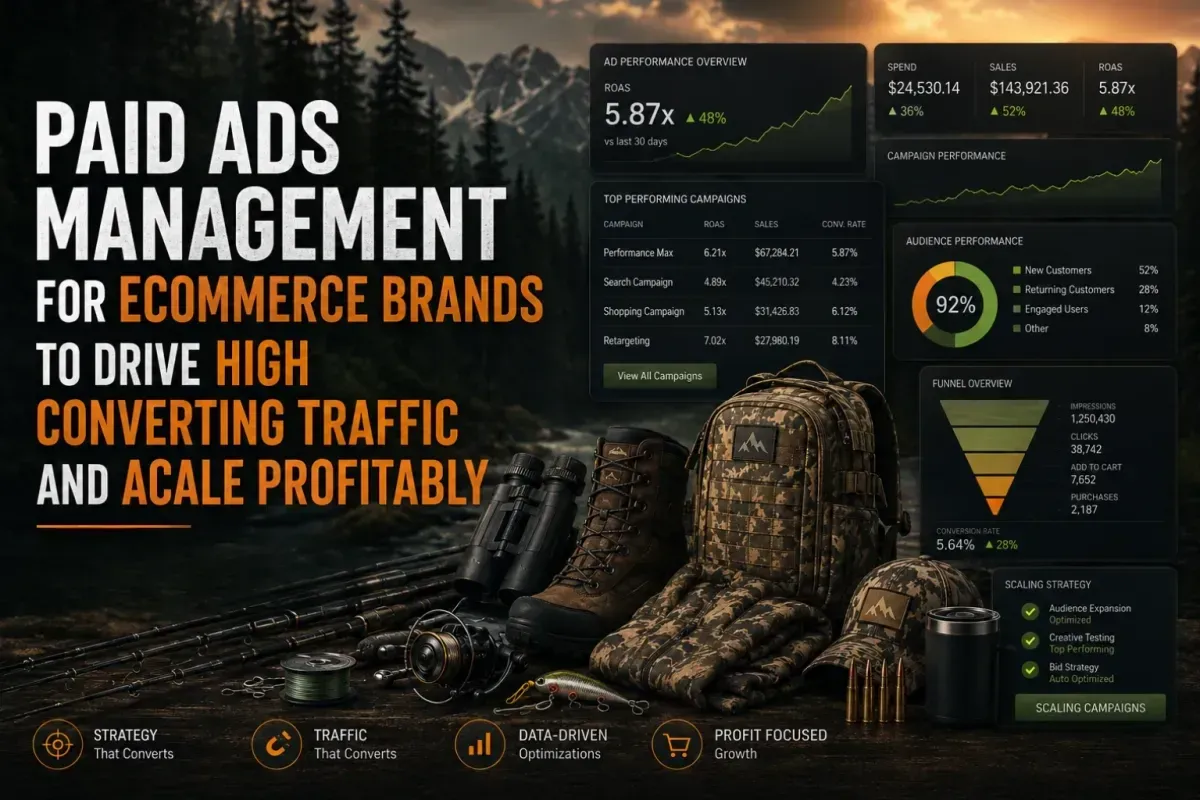
Paid Ads Management for Ecommerce Brands to Drive High Converting Traffic And Scale Profitably
Every ecommerce brand wants more traffic. But the brands that actually scale profitably are not just buying clicks, they are building a precision-engineered paid ads system that turns every dollar of ad spend into measurable, compounding growth. In this guide, we will break down exactly how expert paid ad management works for ecommerce brands, the ecommerce ads strategy that separates thriving stores from struggling ones, and why Amazon paid ads management is a non-negotiable growth lever in 2026.
What Is Paid Ads Management for Ecommerce — And Why Does It Matter?
Paid ads management for ecommerce is the ongoing process of planning, launching, optimizing, and scaling paid advertising campaigns across platforms like Meta, Google, TikTok, and Amazon, with the specific goal of driving high-converting traffic that turns visitors into paying customers.
Unlike general brand awareness campaigns, ecommerce paid ads are built around one core objective: profitable customer acquisition at scale. This means every creative, every audience segment, every bid strategy, and every landing page is measured against return on ad spend (ROAS), cost per acquisition (CPA), and net profit margins.
Most ecommerce brands either underinvest in paid ads and miss massive growth windows, or they overspend without a clear strategy and burn budget with little to show for it. Professional paid ad management bridges this gap, bringing structure, data, and expertise to every campaign decision.
Key Insight: Paid advertising is not an expense, it is an investment. The only difference between it being profitable or not is the strategy, structure, and expertise behind it.
The Foundation — Building a Winning Ecommerce Ads Strategy
A high-performing ecommerce ads strategy is a layered system that covers audience research, funnel design, creative development, platform selection, and continuous optimization. Here is how the best brands approach it.
1. Define Your Customer Avatar Before You Spend a Dollar
Before any campaign goes live, you need clear answers to these questions:
Who is your ideal customer?
What problem does your product solve for them?
What does their purchase journey look like?
What competitors are they currently buying from?
This research phase shapes every targeting decision from Meta interest audiences to Google search keywords to Amazon competitor targeting. Brands that skip this step burn budget on audiences that never had intent to buy.
2. Choose the Right Platform for Your Product and Audience
Meta Ads (Facebook/Instagram): Best for visual products, impulse purchases, and D2C brands. Excellent for building awareness and scaling creatives.
Google Shopping and Search: Best for high-intent buyers actively searching for a product. Drives strong ROAS for established product categories.
TikTok Ads: Ideal for younger demographics and viral product moments. Lower CPMs and growing fast for ecommerce in 2026.
3. Structure Your Ad Funnel — Top, Middle, and Bottom
Top of Funnel (TOFU): Awareness campaigns targeting cold audiences. Focus on thumb-stopping creatives and compelling hooks.
Middle of Funnel (MOFU): Consideration campaigns for warm audiences who visited your site or engaged with your content. Build trust and educate.
Bottom of Funnel (BOFU): Retargeting campaigns for cart abandoners, product page viewers, and past purchasers. These drive the highest ROAS of any campaign type.
If you want to understand how paid ads fit into the bigger picture of scaling your ecommerce business, read our detailed guide on How to Build a Profitable Ecommerce Brand, where we break down the complete full-stack growth system that turns ecommerce stores into high-margin, scalable businesses.
Amazon Paid Ads Management — The High-Intent Growth Channel Most Brands Underutilize
Amazon's advertising platform is uniquely powerful because you are reaching buyers who are already in purchase mode. They are not casually scrolling a social feed, they are on Amazon to buy something. This makes Amazon Sponsored Ads some of the highest-converting paid traffic available to ecommerce brands, but only when managed correctly.
Pillar 1: Sponsored Products Campaigns
Sponsored Products place your listings at the top of search results and on competitor product pages. Effective management involves:
Aggressive keyword research including long-tail and competitor keywords
Tight match type management using exact, phrase, and broad match
Regular bid adjustments based on conversion data
Constant monitoring of ACoS and TACoS to protect profitability
Pillar 2: Sponsored Brands Campaigns
Sponsored Brands appear as banner ads at the top of Amazon search results, showcasing your logo, a custom headline, and multiple products. These build brand recognition on Amazon and capture shoppers who are still comparing options. Over time, a strong Sponsored Brands campaign drives branded search volume, making future ad campaigns cheaper and more effective.
Pillar 3: Sponsored Display and DSP Retargeting
Sponsored Display retargets shoppers who viewed your products but did not purchase both on and off Amazon. Amazon's Demand Side Platform (DSP) takes this further, enabling programmatic display advertising across Amazon-owned properties and third-party websites.
Pro Tip: Paid traffic to an unoptimized Amazon listing is wasted spend. Before scaling Amazon ads, make sure your product title, bullet points, A+ content, and images are fully optimized. Your listing is your landing page.
Creative Strategy - The Difference Between Ads That Convert and Ads That Do Not
In 2026, creative is the single most important variable in paid advertising performance. Targeting is largely automated by algorithms, which means your ad creative is what separates a winning campaign from a money losing one.
High-converting ecommerce ad creatives share these characteristics:
Hook within 1 to 3 seconds: Your opening frame must immediately communicate value or spark curiosity before the viewer scrolls away.
Problem-solution framing: Show the problem your customer faces, then position your product as the clear answer.
Social proof integration: UGC, testimonials, star ratings, and review screenshots dramatically increase conversion rates.
Clear call-to-action: Every ad needs a specific next step — Shop Now, Claim Your Discount, or See Why 10,000 Customers Love This.
Continuous creative testing: Run systematic A/B tests on hooks, visuals, copy, and offers, feed the algorithm winners and cut losers fast.
How to Scale Paid Ads Profitably Without Increasing Risk
Every ecommerce brand hits the same wall when scaling paid ads, performance degrades as budgets increase. CPMs rise, frequency climbs, and ROAS drops. Here is how professional paid ad management approaches sustainable scale:
Horizontal scaling: Expand to new audiences, new platforms, and new geographies instead of just spending more on existing campaigns.
Vertical scaling with guardrails: Increase budgets in 10 to 20 percent increments and monitor metrics for 3 to 5 days before scaling further. Rapid budget jumps destabilize algorithms.
Contribution margin as the north star: Track profitability at the product and campaign level, not just ROAS. A 4x ROAS on a low-margin product can be less profitable than a 2.5x ROAS on a high-margin one.
Retention to reduce customer acquisition cost: Increase customer lifetime value (LTV) through email sequences, SMS flows, and loyalty programs. When customers buy repeatedly, your allowable acquisition cost rises and you can outbid competitors sustainably.
The Profitability Formula: Profitable scaling happens when LTV divided by CAC is greater than 3. If your customer lifetime value is at least three times your customer acquisition cost, you have a scalable paid ads business.
Common Paid Ads Mistakes Ecommerce Brands Must Avoid
Running ads to a poor website experience: Slow load times and weak product pages destroy even the best-targeted campaigns. Audit your site before scaling spend.
Ignoring attribution data: Without proper attribution, you will misallocate budget. Use Google Analytics 4 and third-party tools to understand the full customer journey.
Chasing vanity metrics: Likes and impressions mean nothing if purchases are not happening. Measure revenue, ROAS, CPA, and profit margin.
Neglecting Amazon ads: Amazon buyers convert at significantly higher rates than social traffic. Ignoring Amazon paid ads management leaves your most profitable channel untapped.
No creative refresh cycle: Ad creative fatigues quickly. Refresh new creatives every 2 to 4 weeks or performance will decline steeply.
Frequently Asked Questions
What is paid ads management for ecommerce brands?
Paid ads management for ecommerce brands is the strategic planning, execution, and ongoing optimization of paid advertising campaigns across platforms like Meta, Google, TikTok, and Amazon. It covers audience research, creative development, campaign structure, bid management, and performance analysis to maximize return on ad spend and drive profitable growth.
How much should an ecommerce brand spend on paid ads?
Most ecommerce brands start with a minimum of $3,000 to $5,000 per month to gather meaningful data and test campaigns effectively. Scaling brands often reinvest 15 to 30 percent of revenue back into paid advertising. The right budget depends on your margins, customer lifetime value, and growth targets.
What is a good ROAS for ecommerce paid ads?
A good ROAS depends on your product margins. A 60 percent margin product may be profitable at 2.5 to 3x ROAS. A 20 percent margin product may need 6 to 8x ROAS to break even. Always optimize for net profit margin not ROAS in isolation.
Why is Amazon paid ads management different from other platforms?
Amazon users are active buyers, not passive browsers. Amazon's ad ecosystem is tied directly to purchase intent and keyword relevance, making it more transactional. Amazon ads also influence organic rankings through sales velocity, so well-managed campaigns build long-term organic visibility alongside short-term sales.
How long does it take to see results from paid ads management?
Most brands see meaningful data and early performance signals within 4 to 6 weeks. Consistent profitability and significant scale typically emerge in months 2 to 4 as algorithms optimize, creative testing produces winners, and audience data accumulates.
Should ecommerce brands manage their own paid ads or hire an agency?
Early-stage brands can manage their own ads to learn the basics. But once ad spend exceeds $5,000 to $10,000 per month, the complexity of multi-platform management, creative testing, and attribution typically makes professional paid ad management more cost-effective than doing it in-house.
Final Thoughts
Paid advertising is one of the most powerful growth levers available to ecommerce brands — but only when executed with the right strategy, creative approach, and data discipline. When you combine a smart ecommerce ads strategy with expert Amazon paid ads management and a full-funnel creative system, you stop guessing and start scaling with confidence.
The brands that win in ecommerce are not the ones with the biggest budgets. They are the ones with the most disciplined, data driven approach to paid advertising.



It all starts
with a conversation.
Quick Links
Join Our Newsletter
* Will send you weekly updates for your better tool management.
© 2026 Six Star Brands. Privacy Policy & Terms of Service