
OUR BLOGS
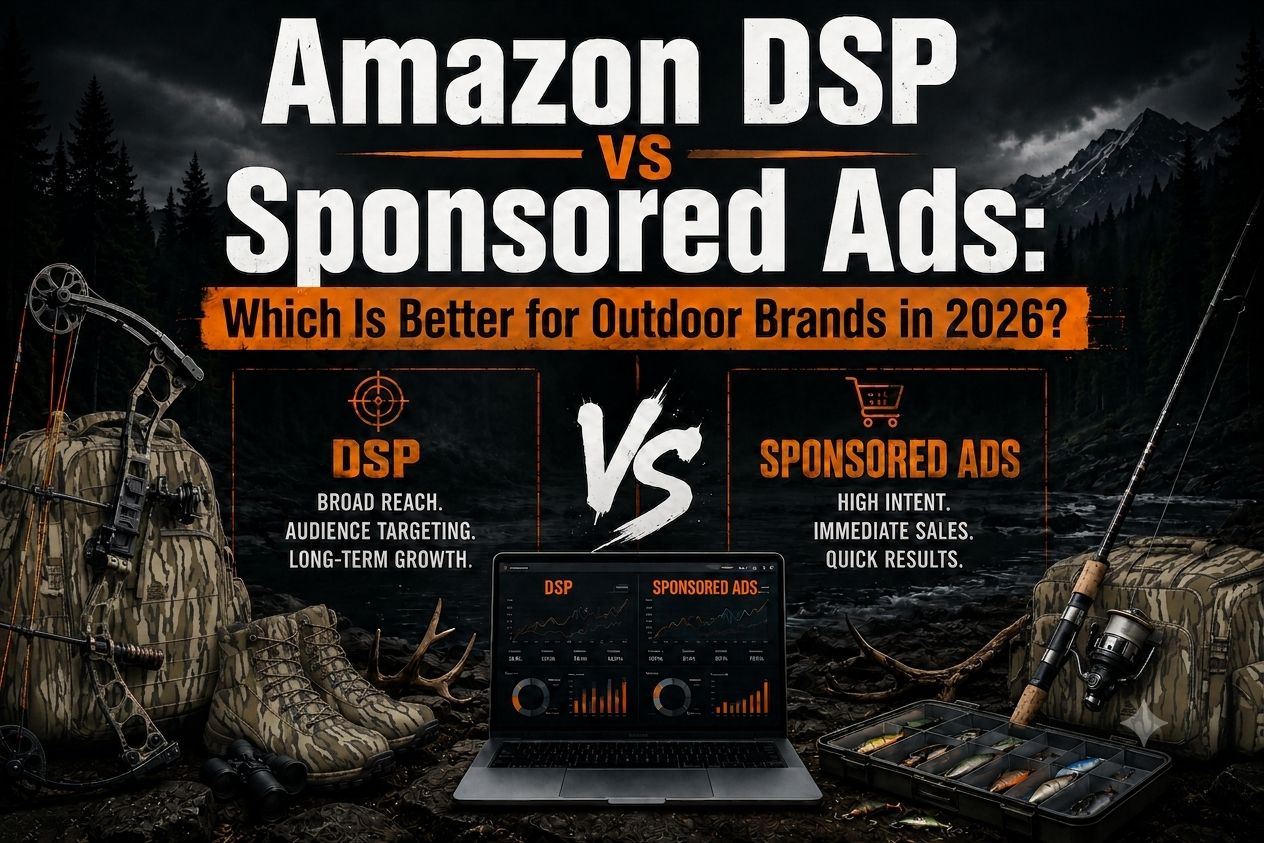
Amazon DSP vs Sponsored Ads | Which Is Better for Outdoor Brands?
Every outdoor brand running Amazon ads faces this question eventually.
You are scaling. Your Sponsored Ads are performing. Someone mentions Amazon DSP. Now you are not sure which direction to go. Or whether you need both.
The answer depends on where your brand is right now. It depends on your budget, your goals, and how mature your amazon ads management services setup actually is.
This guide breaks down both options clearly. No jargon. No fluff. Just the information you need to make the right decision for your hunting, fishing, or outdoor gear brand in 2026.
What Are Amazon Sponsored Ads?
Sponsored Ads are Amazon's pay-per-click advertising system. You only pay when someone clicks your ad.
There are three types most outdoor brands use:
Sponsored Products: appear inside search results and on product detail pages
Sponsored Brands: banner ads at the top of search results showing your logo and multiple products
Sponsored Display: retargeting ads that follow shoppers across Amazon and external sites
Sponsored Ads target shoppers who are actively searching on Amazon right now. The intent is high. The buyer is in purchase mode. They are searching for hunting boots or fishing lures. Your ad appears. They click. They buy.
What Is Amazon DSP?
Amazon DSP stands for Demand-Side Platform. It is a programmatic advertising system. You pay per impression, not per click.
DSP lets you reach audiences both on and off Amazon. You can target shoppers on Amazon.com, IMDb, Twitch, Fire TV, and thousands of third-party websites and apps across the internet.
The targeting power of DSP comes from Amazon's first-party data. Amazon knows what people have searched for, viewed, and purchased. That data is extraordinarily valuable for outdoor brands.
You can target:
Shoppers who viewed your product but did not purchase
Shoppers who purchased competitor products in your category
In-market audiences actively researching hunting or fishing gear
Lifestyle segments like "outdoor enthusiasts" or "avid anglers"
This is upper and mid-funnel advertising. It builds awareness and retargets warm audiences. It creates demand before shoppers even open Amazon to search.
The Core Difference Between DSP and Sponsored Ads
This is the most important thing to understand before making any decision.
Sponsored Ads capture existing demand: A shopper is already searching. Your ad appears in their results. You win the click or you do not.
DSP creates and nurtures demand: A shopper may not be searching yet. DSP puts your outdoor brand in front of them while they are reading outdoor content, watching hunting videos on Twitch, or browsing fishing forums. By the time they open Amazon to search, your brand is already familiar.
Both approaches serve completely different purposes inside a complete retail media strategy. Understanding that difference is the foundation of every decision that follows.
Which One Should Your Outdoor Brand Start With?
The answer is almost always Sponsored Ads first. Here is why.
Start With Sponsored Ads If You Are
New to Amazon advertising: Sponsored Ads have a lower entry cost and faster feedback loops. You learn what keywords convert. You learn what your real ACoS looks like. You build the data foundation your brand needs before adding complexity.
Working with a budget under $10,000 per mont: DSP typically requires a minimum spend of $10,000 per month to run effectively. Below that threshold, Sponsored Ads will always deliver better return on your available budget.
Still optimising your listing: If your conversion rate is below 10%, fix your listing first. DSP driving traffic to a weak listing is expensive waste. Sponsored Ads at a controlled budget will cost you less while you fix the fundamentals.
Launching a new product: New products need reviews and sales velocity before DSP makes sense. Sponsored Ads through an auto-to-manual pipeline builds that foundation efficiently.
When Amazon DSP Makes Sense for Outdoor Brands
DSP is not for every brand. But for the right brand at the right stage, it is a powerful tool inside a complete retail media strategy.
Consider DSP If You Are
Spending $10,000 or more on Sponsored Ads monthly: At this scale your brand has category presence. DSP adds an upper-funnel layer that feeds more shoppers into your Sponsored Ads pipeline below.
Competing in a crowded outdoor category: Hunting and fishing categories are competitive. DSP lets you reach shoppers before they even start comparing brands. You create familiarity before the decision process begins.
Launching a seasonal campaign: Pre-season DSP campaigns for hunting brands, running in July and August ahead of fall season, build brand awareness before the search volume spikes. When shoppers start searching in September, your brand is already top of mind.
Looking to retarget at scale: Sponsored Display does basic retargeting inside Amazon. DSP retargeting is far more powerful. It reaches shoppers across the entire internet and brings them back to your product pages with more precision and frequency.
How DSP and Sponsored Ads Work Together
The most effective outdoor brands do not choose between DSP and Sponsored Ads. They use both as layers in an integrated retail media strategy.
Here is how the layers work together:
DSP awareness campaigns: reach outdoor enthusiasts across the internet. Hunters watching YouTube hunting content. Anglers reading fishing blogs. They see your brand before they are ready to buy.
Sponsored Brands campaigns: capture shoppers at the top of Amazon search. They are now in the research phase. They see your brand banner. They recognise it from earlier touchpoints. Familiarity builds trust. Click-through rates improve.
Sponsored Products campaigns: close the sale. The shopper knows what they want. They search for it. Your product appears. They have seen your brand before. They click and convert.
DSP retargeting campaigns: recover the ones who did not buy. A shopper viewed your hunting knife but left without purchasing. DSP follows them to other sites and brings them back. Conversion happens on the second or third touchpoint.
This full-funnel approach is what separates brands that dominate their outdoor category from those that fight over the same bottom-of-funnel clicks.
Cost Comparison: DSP vs Sponsored Ads
Understanding the cost structure of each channel is critical before making any investment decision.
Sponsored Ads Costs
Sponsored Ads use a pay-per-click model. You set bids. You pay only when someone clicks.
Average CPC in outdoor categories ranges from $0.50 to $2.50 depending on competition and keyword specificity. You can start with as little as $500 per month and scale from there.
The cost is directly tied to performance. If clicks are not converting, you adjust bids or pause keywords. The feedback loop is fast and the control is high.
DSP Costs
DSP uses a CPM model, cost per thousand impressions. You pay whether someone clicks or not.
Amazon's managed DSP service typically requires a minimum spend of $10,000 per month. Self-service DSP access through an agency can lower that threshold somewhat.
The return on DSP is measured differently. You are not optimising for direct ACoS. You are measuring new-to-brand customer rates, detail page view rates, and the halo effect on total attributed sales including Sponsored Ads.
What Professional Amazon Ads Management Services Look Like for Both Channels
Managing Sponsored Ads and DSP together requires different skill sets.
Sponsored Ads management is tactical and data-intensive. It requires weekly search term analysis, bid adjustments, negative keyword management, and campaign structure optimisation.
DSP management requires audience strategy, creative development, frequency capping, and cross-channel attribution analysis. It is a fundamentally different discipline.
When you work with professional amazon ads management services, you get both skill sets under one roof. Your Sponsored Ads and DSP campaigns are built to work together. The data from each channel informs the other. Your retail media strategy becomes a system rather than a collection of disconnected campaigns.
That integration is where the real competitive advantage lives for outdoor brands in 2026.
The Decision Framework: DSP vs Sponsored Ads for Your Outdoor Brand
Use this to make your decision right now.
Start with Sponsored Ads only if:
Your monthly ad budget is under $10,000
You are still building reviews and sales velocity
Your listing conversion rate is below 10%
You are launching a new product or entering a new category
Add DSP alongside Sponsored Ads if:
Your Sponsored Ads spend exceeds $10,000 per month
Your core listings have 50 or more reviews and strong conversion
You are preparing for a seasonal peak like hunting season
You want to build brand recognition beyond Amazon search
Use both as an integrated system if:
You are a category leader or aiming to become one
You want to build a defensible brand position that competitors cannot replicate with bids alone
You are working with a full-service team that understands both channels
Ready to Build the Right Strategy for Your Outdoor Brand?
The right choice between DSP and Sponsored Ads is not universal. It depends entirely on where your brand is right now and where you are trying to go.
What is universal is this: both channels work better as part of a complete, integrated system than they ever do in isolation.
To understand how paid advertising fits into a full growth system for your outdoor brand, visit our full-stack ecommerce growth page. Or explore our paid ads management services to see how we build and manage both channels for hunting and fishing brands.
You can also read our main guide on Amazon PPC & Paid Adsfor Outdoor Brands to see the complete paid advertising strategy behind what we build.
Frequently Asked Questions
What is the minimum budget for Amazon DSP?
Amazon's managed service requires a minimum spend of around $10,000 per month. Self-service DSP accessed through an agency can sometimes lower this threshold. Sponsored Ads have no minimum and can start from a few hundred dollars per month.
Can small outdoor brands use Amazon DSP?
Most small brands should prioritise Sponsored Ads first. DSP delivers its best results at higher budgets where enough impressions can build meaningful frequency and attribution data. Under $10,000 per month, Sponsored Ads will almost always deliver stronger returns.
Is Amazon DSP only for large brands?
Not exclusively. But it is most effective for brands with established listings, strong conversion rates, and enough budget to generate meaningful impression volume. It is a scaling tool, not a launch tool.
How do I measure DSP performance for my outdoor brand?
Key DSP metrics include new-to-brand customer rate, detail page view rate, purchase rate, and total attributed sales. Unlike Sponsored Ads, DSP performance is often measured by its impact on total account revenue rather than direct ACoS.
What is retail media strategy and why does it matter?
Retail media strategy is your plan for how you use advertising across retail platforms like Amazon to build brand awareness, capture demand, and retarget shoppers at every stage of the buying journey. A strong retail media strategy uses DSP and Sponsored Ads together as a coordinated system rather than isolated campaigns.
Do I need separate agencies for DSP and Sponsored Ads?
No, The best approach is working with a single team that manages both channels together. When DSP and Sponsored Ads share the same strategy, the data from each channel strengthens the other. Separate agencies create silos that hurt overall performance.

It all starts
with a conversation.
Quick Links
Join Our Newsletter
* Will send you weekly updates for your better tool management.
© 2026 Six Star Brands. Privacy Policy & Terms of Service