
OUR BLOGS
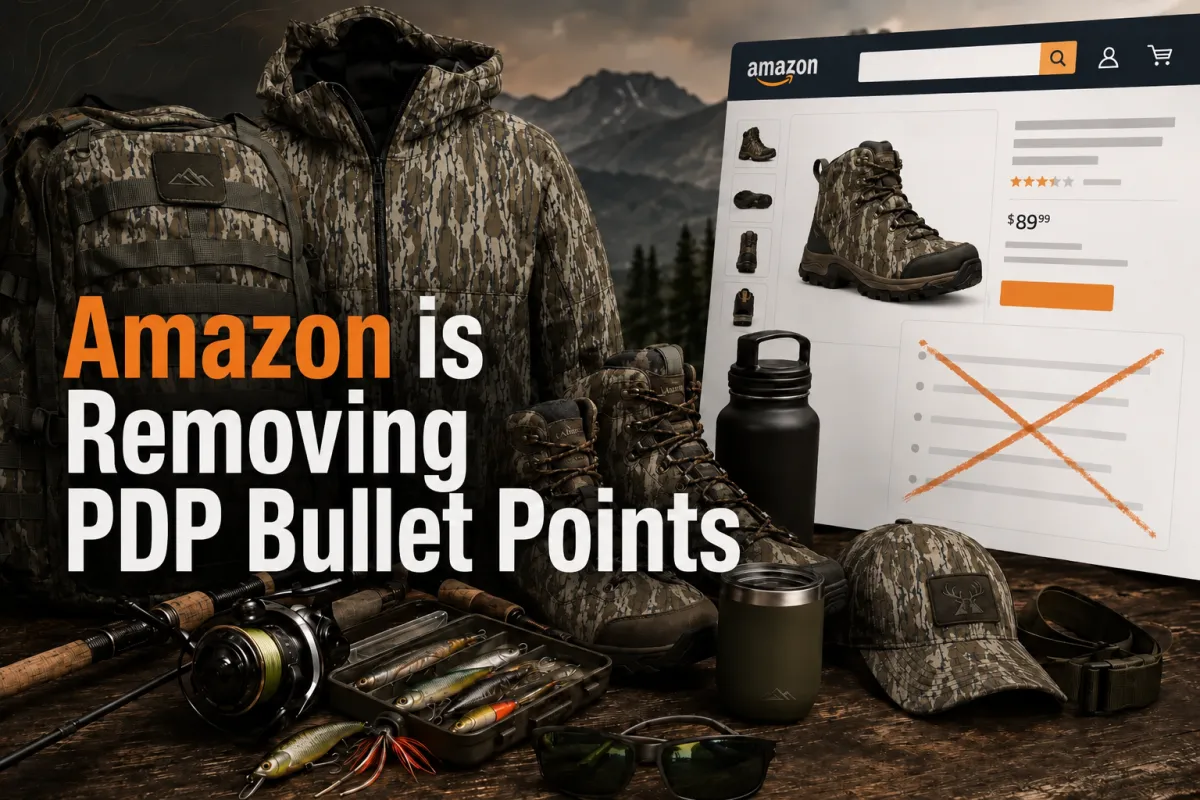
Amazon Listing Optimization for Outdoor Brands - Bullet Points Replaced by Rufus AI
If you sell on Amazon, a change is being quietly tested right now that has the potential to reshape how every shopper interacts with your product listing. Amazon appears to be removing bullet points from product detail pages entirely, replacing them with something very different, powered by AI.
For outdoor and hunting brand sellers, this deserves your immediate attention. Bullet points have been one of the few places on Amazon where you, the seller, have had direct and unfiltered control over what a shopper reads. That control may be going away and the brands that are not prepared will feel it in their conversion rates before they even understand what changed.
What the Know Before You Buy Section Actually Looks Like
On the listings where this change has been spotted, the standard five-bullet feature section is completely gone. Every Amazon seller reading this knows exactly what that section looks like, it sits below the price and Add to Cart button, and for years it has been the primary real estate for communicating your product's value to a shopper who is close to making a decision.
In its place is a set of audience-grouped prompts under the heading Know Before You Buy. The prompt groups are structured around inferred buyer categories, such as:
For You
For the Enthusiast
For the Gift Buyer
For the Experienced User
Each prompt, when clicked, opens Rufus directly and triggers the AI to answer a related question about the product. The answers Rufus provides are not pulled from your bullet points. They are generated from whatever content exists across your full listing, your title, product description, A+ Content, and the attribute fields you have populated in Seller Central.
That is the core shift. Instead of reading what you wrote, shoppers are now asking a question and receiving an AI-generated answer. You are no longer the copywriter in that moment. Rufus is.
Why Amazon Is Making This Change
The Rise of Rufus as a Shopping Assistant
To understand why Amazon is testing this, you have to understand where the company has been directing its development resources. Rufus is Amazon's generative AI shopping assistant, launched broadly in 2024 and expanded into the core mobile shopping experience in 2025. Instead of typing a product name and scrolling a grid, shoppers now ask Rufus things like "What is a good trail camera for low light?" or "Which hunting blind is easiest to set up alone?" and Rufus returns a conversational answer that often includes two to four recommended products.
Per Amazon's Q4 2025 earnings disclosure, Rufus reached 300 million active users and is generating around $12 billion in incremental annualized sales. Amazon is not running consumer-facing tests without clear intent behind them.
Bullet Points Were Always a Workaround
Bullet points were the best available tool in a static content environment but they were also inconsistent, often keyword-stuffed to the point of being unreadable, and rarely written to answer the specific question a given shopper was actually trying to resolve. Rufus solves that problem from Amazon's perspective. Instead of every shopper reading the same five bullets regardless of their individual use case, Rufus can respond to each shopper's specific question with a dynamically generated, relevant answer.
During the 2025 holiday season, Rufus appeared in 38% of shopping sessions, and those sessions converted at 3.5x higher rates on Black Friday. Amazon knows its own data. This test is entirely consistent with that direction.
What This Means for Amazon Listing Optimization in 2026
Keywords Still Matter - But the Strategy Shifts
The instinct many sellers have when they hear about this is to panic about keyword placement. If bullet points disappear from the visible page, does keyword strategy inside them stop mattering? The honest answer is more nuanced than a simple yes or no.
Keywords still matter, but they are only one layer. Treat your title, bullets, description, and A+ Content as connected semantic data sources. A strong listing should not only list features, it should clearly communicate usage scenarios, target users, and concrete problems solved.
Amazon indexing your bullet point content and Amazon displaying your bullet point content to shoppers are two different things. Even if bullets are hidden or removed from the shopper-facing page, they may still be read by the algorithm for indexing purposes. What is definitely changing is where the actual selling happens and that now increasingly runs through Rufus.
Rufus Does Not Read Like a Shopper - It Reads Like a System
Rufus does not use the same ranking signals as A9. It reads your full listing, including review content, Q&A, A+ Content text, and backend attributes and synthesizes whether your product actually fits the shopper's intent.
This means the parts of your listing that many sellers treat as secondary, the product description, the A+ Content modules, the attribute fields, are now potentially the primary source material for the AI making your case to shoppers.
Rufus interprets your listing semantically rather than matching keywords, which means completeness, accuracy, and specificity matter more than keyword density. It also catches contradictions. If your bullets claim unbreakable construction and twelve reviews mention cracking, Rufus deprioritizes your listing for durability queries. A9 would still surface it on keyword match alone. That is a significant difference outdoor brand sellers cannot afford to ignore.
The Listing Elements That Will Matter Most Going Forward
1. Your Product Title
The title remains your single most important listing element in almost any scenario and it becomes even more critical in a Rufus-first environment. It is the anchor content Rufus uses to identify what your product is before pulling supporting detail from everywhere else on your listing.
For outdoor and hunting brands, a strong title should include:
Your primary category keyword, hunting blind, trail camera, fishing rod, kayak paddle, and so on
The key use case or environment your buyer actually cares about
A differentiating attribute such as material, size, compatibility, or a key performance specification
Your brand name positioned naturally within the title structure
Write your title for the shopper first and the algorithm second. Rufus rewards titles that clearly communicate what a product is and who it is for.
2. Your Product Description
For sellers who have treated the product description as an afterthought, a place to dump extra keywords or paste a slightly reworded version of the bullet points, this needs to change now. The product description is the long-form content source Rufus draws on most heavily when answering detailed, specific pre-purchase questions from shoppers.
Write your description in natural, complete sentences. Cover the real-world situations where your product performs at its best. For a hunting blind, that means describing exactly how fast it sets up in low light before a morning hunt, how well it handles wind and rain, and what terrain it is built for. For a trail camera, it means walking through how it performs in dense canopy cover, extreme cold, or low-battery conditions. Specificity is what makes Rufus's answers useful and useful Rufus answers convert.
3. A+ Content Modules
A+ Content has absorbed the long-form selling work that bullet points used to do. Now modules, comparison charts, and lifestyle imagery carry that storytelling weight. In a Rufus-first environment, every A+ module also becomes potential source material for AI-generated answers to shopper questions.
If your A+ Content currently consists of generic brand storytelling or repeats the same information as your bullets without adding depth, it needs a strategic overhaul.
Build modules that address specific questions your outdoor buyers actually ask:
How does this product perform in wet, cold, or high-humidity conditions?
What is included in the package and what needs to be purchased separately?
How does this model compare to the previous version or a competing product?
What is the correct size or configuration for a specific hunting or fishing application?
Each module you build that answers a real question is another piece of content Rufus can draw from when representing your product to a shopper.
4. Backend Attributes and Data Fields
Every attribute field Amazon provides in Seller Central exists for a reason, and Rufus draws directly on structured attribute data to answer the factual questions shoppers ask. Dimensions, weight, material composition, compatibility, included accessories, and technical specifications should all be filled out completely and accurately.
This matters especially for outdoor and hunting brands, where technical details drive purchase decisions. A buyer asking Rufus whether a kayak paddle fits a specific shaft diameter needs accurate attribute data to receive a useful answer. A buyer asking about the effective range of a trail camera at night needs that specification entered correctly in the product attributes. If Rufus describes your product incorrectly because attribute fields are wrong or missing, that is a direct conversion problem and for outdoor brands, where accuracy builds trust, it also damages your brand credibility.
The Broader Shift Amazon Is Signaling to Sellers
This test is not happening in isolation. It sits within a consistent pattern of Amazon using AI to take greater control over how shoppers experience product pages.
Amazon is also testing a redesigned product detail page that collapses key elements, including bullet points, into dropdown menus to encourage customer interaction rather than passive reading. Core item details have been moved from the bottom of the page to a new dropdown under the product title, and the design is clearly optimized for mobile-first browsing.
Mobile share of Amazon shopping crossed 79% in 2026. On the mobile PDP, bullets sit below the image carousel and the variation picker. Eye-tracking data from 1,200 mobile sessions shows the median shopper reads just 1.4 bullets before bouncing to images, jumping to reviews, or scrolling to A+ content.
Amazon is reading this behavioral data and building accordingly. The brands that will hold their ground are the ones whose listings give Rufus enough rich, accurate, and specific content to represent them well in every type of shopper conversation, regardless of whether bullet points remain visible or not.
Common Mistakes That Will Hurt Outdoor Brand Sellers in a Rufus-Powered Environment
As you audit your listings against this new reality, these are the patterns that consistently underperform and that outdoor brand sellers need to eliminate from their content strategy:
Generic opener language: Rufus ignores marketing language like "PREMIUM QUALITY" or "BEST IN CLASS", it looks for specific, verifiable product attributes. For outdoor brands, that means exact specs, real-world performance claims, and use-case specificity.
Thin A+ Content: Two or three basic modules with stock text no longer provide enough content depth for Rufus to work with. Categories where A+ Content has real depth and specificity are reporting meaningful organic ranking advantages.
Single-use-case positioning: Products positioned for exactly one use case are missing Rufus-mediated discovery for adjacent use cases. A hunting blind that is also ideal for turkey season, wildlife photography, or bow hunting should say so explicitly across your listing content.
Incomplete attribute fields: Blank fields mean Rufus has nothing to draw from when answering factual questions. For outdoor products with technical specifications, this is a direct and avoidable conversion killer.
Copy written for the algorithm, not the customer: AI amplifies either signal or noise. Signal means the exact phrases buyers use in reviews and real search terms. Noise means assumptions about what customers care about. Hand the system noise and every piece of content drifts further from what the buyer needs to hear before clicking Add to Cart.
What Outdoor Brand Sellers Should Do Right Now
You cannot control whether Amazon removes your bullet points. What you can control is how well your listing performs when Rufus is the one making your case to shoppers. Here is where to start:
Audit your product descriptions across your full catalog: Rewrite any that are thin, repetitive, or built around keyword placement rather than genuine buyer education. Write in natural language that answers the questions a hunter, angler, or outdoor enthusiast would actually ask before making a purchase.
Review your A+ Content with fresh eyes: Ask whether each module answers a real question a real buyer would have and whether it provides enough specificity for Rufus to give a useful, accurate answer on your behalf.
Fill out every backend attribute field in Seller Central: For outdoor brands with technical products, this step alone can meaningfully improve how Rufus represents your product in AI-generated answers.
Test Rufus yourself: Open the Amazon app, search for your product category, and ask Rufus the questions your customer would ask. See what answers it generates about your products and your competitors. That exercise alone will show you exactly where your listing content is falling short.
At Six Star Brands, we work exclusively with outdoor and hunting brands on Amazon, from Amazon listing optimization and A+ Content strategy to full catalog management and paid advertising. If you want your listings reviewed and rebuilt to perform in the environment Amazon is building toward, reach out to our team for a free growth audit.
Frequently Asked Questions
What is the Know Before You Buy section on Amazon?
Know Before You Buy is a new section Amazon is testing on product detail pages. It replaces the traditional bullet point section with AI-generated prompts that, when clicked, open Rufus, Amazon's conversational AI shopping assistant, to answer questions about the product. Prompts are grouped by inferred audience category to match each shopper's specific use case or intent.
Is Amazon removing bullet points from all listings?
At the time of writing, the removal of bullet points has been observed on specific listings as part of an active test. Amazon has not made a public announcement about removing bullet points across all product detail pages, but the test is consistent with Amazon's broader and ongoing investment in Rufus and AI-powered shopping experiences.
Will my Amazon SEO keywords still matter if bullet points are removed?
Yes, but the emphasis shifts significantly. If bullet points are removed from the visible page display, keyword content in your title, product description, and backend fields becomes even more critical, both for indexing and for providing Rufus with the source material it needs to answer shopper questions accurately.
What is Rufus on Amazon?
Rufus is Amazon's AI shopping assistant, now also referred to as Alexa for Shopping, integrated directly into the Amazon app and desktop experience. It answers pre-purchase questions by drawing on product listing content, customer reviews, and Q&A data to help shoppers make decisions without needing to read an entire listing.
How should outdoor brand sellers prepare their listings for Rufus?
Focus on content depth across every listing element. Write detailed product descriptions in natural language. Build A+ Content modules that address real use cases and common buyer questions relevant to your outdoor category. Fill out all backend attribute fields completely and accurately. The goal is to give Rufus enough high-quality source material to accurately represent your product to every type of shopper asking about it.
Does the Rufus AI change affect Amazon listing optimization strategy for outdoor brands?
Brands can no longer rely on bullet points and backend keywords alone. If your content is not aligned with the way Rufus understands and recommends products, it is likely invisible in this new era of discovery. For outdoor brands specifically, where buyers ask highly specific questions about performance, compatibility, and use case, listing optimization in 2026 means building content that serves both the A9 algorithm and Rufus's semantic understanding of your listing.



It all starts
with a conversation.
Quick Links
Join Our Newsletter
* Will send you weekly updates for your better tool management.
© 2026 Six Star Brands. Privacy Policy & Terms of Service