
OUR BLOGS
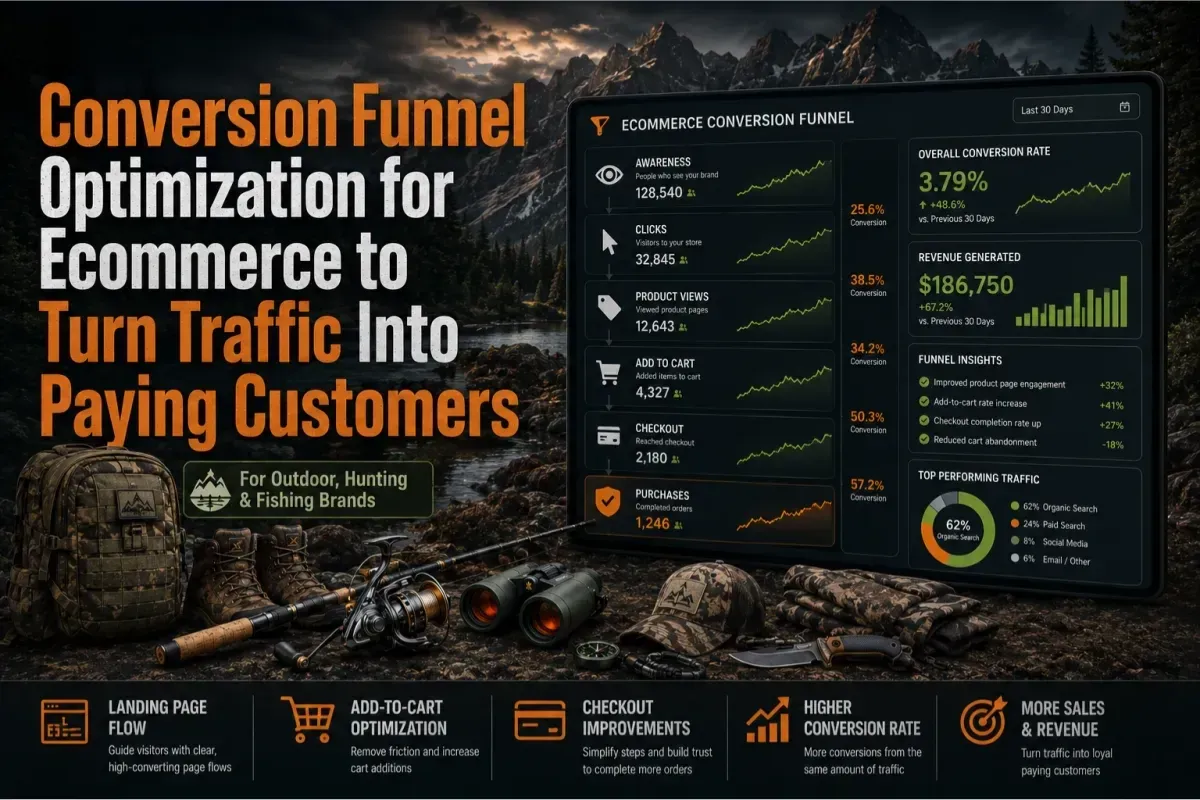
Conversion Funnel Optimization to Turn Traffic to Sales
There is a painful irony that most ecommerce brands discover after spending heavily on paid traffic. The ads are running. The clicks are coming in. Sessions are up. And yet sales are not moving in the same direction. The traffic is real. The interest is real. But somewhere between the ad click and the checkout button, shoppers are disappearing and most brands have no clear idea where or why.
This is a conversion funnel problem. And it is far more common than most ecommerce brands realize. The instinct when sales are slow is to spend more on ads, test new creatives, or chase a different audience. But if your funnel is leaking, sending more traffic into it does not fix the leak. It just costs more money to produce the same underwhelming results.
Conversion funnel optimization is the discipline of finding exactly where shoppers drop off, understanding why they leave without buying, and systematically fixing every point of friction between the first impression and the completed purchase. Done properly, it is one of the highest-return investments an ecommerce brand can make because it multiplies the value of every traffic source you already have without requiring a single additional dollar of ad spend.
What a Conversion Funnel Actually Is — And Why Most Ecommerce Brands Get It Wrong
A conversion funnel is the journey a shopper takes from their first contact with your brand to completing a purchase. Every ecommerce brand has one, whether they have deliberately designed it or not. The question is not whether you have a funnel, it is whether your funnel is working.
The reason most ecommerce brands get this wrong is that they think about their funnel in terms of pages rather than psychology. They map out a homepage, a product page, a cart page, and a checkout page and assume that as long as those pages exist and load reasonably fast, the funnel is functional. What they miss is that a funnel is not a set of pages. It is a sequence of decisions a shopper makes, each one influenced by what they see, read, feel, and trust at that specific moment.
Every stage of your funnel corresponds to a question in the shopper's mind. At the awareness stage, the question is: is this brand worth paying attention to? At the consideration stage: is this the right product for my specific need? At the decision stage: can I trust this brand enough to give them my money? At the checkout stage: is this transaction easy, safe, and worth completing right now?
Conversion funnel optimization means giving shoppers the right answer to each of those questions at the right moment. When you do that consistently across every stage, drop-off rates fall, conversion rates rise, and the same traffic budget generates dramatically more revenue.
Mapping Your Funnel — You Cannot Fix What You Cannot See
Before any optimization work can begin, you need a clear picture of exactly how shoppers are moving through your funnel and where they are leaving. This is not guesswork — it requires data. And most ecommerce brands are sitting on far more useful data than they are actually using.
The Metrics That Reveal Where Your Funnel Is Broken
Your analytics platform, whether Google Analytics 4, Shopify Analytics, or a third-party tool — contains a detailed record of how shoppers move through your store. The funnel metrics that matter most are not vanity metrics like total sessions or page views. They are the transition rates between stages.
What percentage of shoppers who land on a product page add the product to their cart? What percentage of shoppers who add to cart reach the checkout page? What percentage of shoppers who begin checkout complete the purchase? Each of these transition rates is a diagnostic. A low add-to-cart rate points to a product page problem — weak copy, poor images, unclear value proposition, or trust issues. A high cart abandonment rate points to a friction problem, unexpected costs, a clunky checkout flow, or insufficient payment options. A high checkout abandonment rate points to trust or urgency issues at the final decision moment.
When you map these transition rates across your entire funnel, the leaks become visible. And once the leaks are visible, you can prioritize which ones to fix first based on where the biggest volume of shoppers is dropping off.
Qualitative Data — Understanding the Why Behind the Numbers
Quantitative data tells you where shoppers leave. It does not tell you why. For that, you need qualitative research tools. Heatmaps show you where shoppers click, scroll, and linger on each page, revealing which elements are capturing attention and which are being ignored entirely. Session recordings let you watch anonymized replays of real shopper journeys through your store, revealing friction points and moments of confusion that no amount of analytics data would show you. On-site surveys and post-exit feedback tools ask shoppers directly what prevented them from buying and the answers are frequently surprising, specific, and immediately actionable.
The combination of quantitative funnel data and qualitative behavioral research gives you the complete picture needed to prioritize your conversion funnel optimization work intelligently rather than guessing at solutions.
Top of Funnel — Making the Right First Impression
The top of your conversion funnel is where shoppers first encounter your brand — through an ad, a search result, a social post, or a referral. The single job of this stage is to earn the click and deliver a first impression strong enough to make the shopper want to go deeper. Most ecommerce brands underinvest in this stage because it feels like an advertising problem rather than a funnel problem. In reality, the two are inseparable.
Ad Creative and Landing Page Alignment
One of the most common and damaging conversion killers in ecommerce is the disconnect between an ad and the page it leads to. A shopper clicks an ad for a specific product at a specific price point and lands on a generic homepage. Or they click an ad featuring a particular use case and land on a product page that does not reflect that use case at all. The shopper's expectation, built by the ad, is immediately violated. They leave.
This is called message mismatch, and it inflates your bounce rate, destroys your conversion rate, and wastes your ad spend simultaneously. Every ad should lead to a landing page or product page that precisely mirrors the promise, the offer, the visual language, and the specific product or collection featured in the ad. When what the shopper sees after clicking matches exactly what made them click, the funnel flows naturally to the next stage.
What Your Landing Page Must Communicate in the First Three Seconds
A shopper who arrives at your landing page makes a stay-or-leave decision within the first three seconds. In that window, they form an impression based almost entirely on visual design, the headline, and the primary image. This above-the-fold experience is the most valuable real estate in your entire funnel and it needs to do three things instantly.
It needs to confirm that they are in the right place, that this page is about the thing they clicked to find. It needs to communicate a clear, compelling value proposition, not what your product is, but what it does for the customer. And it needs to signal trustworthiness through professional design, recognizable brand elements, and the absence of anything that feels cheap, cluttered, or suspicious.
If your above-the-fold experience fails on any of these three counts, a significant percentage of your traffic will never scroll further, regardless of how good the rest of your page is.
Landing Page Optimization — The Engine of Conversion Funnel Performance
Landing page optimization is the process of continuously improving the pages where traffic arrives to maximize the percentage of visitors who take the desired next action, whether that is making a purchase, adding a product to cart, or entering an email address. It is both an art and a science, combining persuasive copywriting, visual design, user experience principles, and rigorous testing.
The Hierarchy of a High-Converting Landing Page
A high-converting ecommerce landing page follows a logical psychological progression that mirrors how a shopper builds confidence toward a purchase decision. It does not dump all information at once. It earns attention, builds interest, creates desire, and removes objections in a deliberate sequence.
The headline earns attention by speaking directly to the customer's desire or problem. The subheadline clarifies the value proposition, what the product does and for whom. The hero image or video shows the product in a real-world context that the target customer recognizes and relates to. The features and benefits section explains what the product does and why those capabilities matter to this specific buyer. The social proof section, reviews, ratings, user-generated content, press mentions, builds the trust that justifies the purchase decision. The call to action converts intent into action with a clear, low friction next step.
Each of these elements has one job. When any one of them underperforms, the entire page suffers. Landing page optimization identifies which element is the weakest link and improves it, then moves to the next weakest link, and the next.
Copy That Converts — Writing for the Buying Decision, Not the Brand
The most common copywriting mistake on ecommerce landing pages is writing from the brand's perspective rather than the customer's. Copy that talks about how long the company has been in business, how passionate the team is about their products, or how high-quality the materials are, before establishing why any of that matters to the person reading it, fails to connect.
High-converting landing page copy starts with the customer. It names the specific situation they are in, the specific problem they are experiencing, or the specific outcome they are pursuing. It speaks their language, the words they actually use to describe their need, not the words your internal team uses to describe your product. It addresses the objections they are most likely to have before those objections can cause them to leave. And it creates a genuine reason to act now rather than return later or never.
Page Speed — The Silent Conversion Killer
Every second of load time your landing page takes costs you a measurable percentage of conversions. Research consistently shows that a one-second delay in page load time reduces conversions by 7 percent. For a store doing meaningful revenue, that number compounds into significant lost sales every single day. Mobile shoppers are even less forgiving, a page that loads in four seconds on mobile loses a large majority of its visitors before they ever see your headline.
Page speed optimization is not glamorous, but it is one of the highest-leverage interventions in landing page optimization. Compress your images. Minimize your scripts. Eliminate unnecessary apps and plugins. Use a content delivery network. Test your page speed on both desktop and mobile using Google's PageSpeed Insights and treat the results as a priority, not a backlog item.
Mobile Experience — Where Most Ecommerce Funnels Leak the Most
The majority of ecommerce traffic today arrives on mobile devices. Yet the majority of ecommerce brands still design their funnels primarily for desktop. The result is landing pages that technically work on mobile but deliver a frustrating experience, tiny text, buttons that are hard to tap, forms that are difficult to fill on a small screen, and images that do not display correctly in portrait orientation.
Mobile landing page optimization is not about making your desktop page smaller. It is about redesigning the mobile experience from scratch around the constraints and behaviors of a mobile shopper. Larger tap targets. Shorter paragraphs. Sticky add-to-cart buttons. Autofill-enabled form fields. Single column layouts that read naturally on a narrow screen. Every friction point you remove from the mobile experience directly improves your mobile conversion rate.
Middle of Funnel — Turning Interest Into Intent
The middle of your conversion funnel is where most ecommerce brands lose the largest volume of potential customers. A shopper arrives on a product page, spends time reading, scrolls through images, maybe reads a few reviews and then leaves without adding to cart. They were interested. They were considering. But something failed to push them from consideration to decision.
Product Pages as Sales Documents
Your product page is not an information page. It is a sales document. Every element on it should be working to move the shopper closer to the purchase decision and anything that does not serve that purpose is either neutral noise or active distraction.
The product title should be clear and descriptive, matching the language the shopper used to find this page. The product images should answer every visual question the shopper might have, what it looks like from every angle, how it compares in size to a familiar object, what it looks like in use. The product description should address the specific concerns and desires of your target buyer, not recite technical specifications in isolation. The reviews section should be prominently placed and easy to scan because social proof at this stage is often the deciding factor for a shopper who is almost convinced but not quite.
Addressing Objections Before They Become Reasons to Leave
Every product has a set of common objections that prevent otherwise interested shoppers from buying. For a high-ticket item, the objection might be price, is this worth the investment? For a new brand, it might be trust, will this actually be as good as it looks? For a product with sizing or fit considerations, it might be uncertainty, what if it does not fit? For any product with a functional promise, it might be skepticism, will this actually do what it claims?
The most effective product pages do not wait for shoppers to raise these objections internally and then leave. They identify the top two or three objections for their specific product and address them proactively and directly in the product copy, through FAQs embedded on the page, through review highlights that speak to those specific concerns, and through risk-reduction elements like money back guarantees, free returns, and clear sizing guides.
Bottom of Funnel — Removing Every Barrier Between Intent and Purchase
A shopper who reaches your cart or checkout page has already made the hardest decision — they want your product. The only thing standing between you and a completed sale at this point is friction. Unexpected costs. A complicated checkout flow. A lack of trusted payment options. Doubt about security. Anything that makes completing the purchase feel harder or riskier than the shopper expected will cause them to abandon.
Cart Page Optimization
The cart page is not just a holding area before checkout. It is an active selling environment that can either accelerate the purchase decision or introduce second thoughts. A well-optimized cart page clearly summarizes what the shopper is buying and what they will pay — with no surprises. It reinforces the value of the purchase with a brief reminder of the key benefit or the offer. It displays trust signals, secure checkout badges, return policy reminders, customer service accessibility. And it keeps the path to checkout as short and direct as possible.
Cart pages that try to do too much, aggressive upsell popups, distracting promotional banners, complicated coupon code interfaces, often introduce friction and doubt at exactly the wrong moment. Every element you add to a cart page should be evaluated against one question: does this make it more likely that this shopper will complete their purchase, or less?
Checkout Flow Optimization
Checkout abandonment is the most expensive leak in any ecommerce funnel because it happens at the moment of maximum purchase intent. A shopper who abandons checkout was one step away from being a customer. Recovering even a fraction of those abandonments through checkout optimization generates significant revenue without any additional traffic cost.
The most impactful checkout optimizations are consistent across most ecommerce brands. Reduce the number of steps and form fields to the absolute minimum required. Display shipping costs and delivery estimates before the final step, unexpected shipping costs at checkout are the single most cited reason for cart abandonment. Offer multiple payment options including digital wallets like Apple Pay and Google Pay, which dramatically reduce checkout friction on mobile. Show clear security indicators throughout the checkout flow. And make it easy to checkout as a guest, requiring account creation before purchase is a significant conversion barrier for first-time buyers.
Related Read: Conversion funnel optimization works best when your paid traffic strategy is equally strong. Read our guide on profitable ecommerce brand to understand how these two growth levers work together to compound your results at Six Star Brands.
Post-Purchase — The Stage of the Funnel Most Brands Completely Ignore
The conversion funnel does not end at purchase. For ecommerce brands focused on long-term profitability, what happens after the first purchase is just as strategically important as what happens before it. A customer who buys once and never returns has a lifetime value equal to a single transaction. A customer who buys repeatedly has a lifetime value that can be ten or twenty times higher and they cost nothing to acquire the second time.
Post-purchase funnel optimization focuses on delivering an exceptional experience from the moment of purchase through delivery and beyond, turning first-time buyers into repeat customers and brand advocates. Order confirmation emails that set clear expectations for delivery. Shipping update communications that reduce anxiety. An unboxing experience that reinforces the quality of the purchase decision. A post-purchase email sequence that introduces the customer to related products, shares usage tips, and invites a review at the right moment.
These touchpoints are not overhead. They are conversion opportunities for the next purchase and they cost a fraction of what it takes to acquire a new customer from scratch.
Testing — The Only Way to Know What Actually Works
Every optimization hypothesis, no matter how logical, how strongly the data suggests it, or how confidently an expert recommends it, is just a hypothesis until it is tested. The only way to know with certainty whether a change to your funnel improves conversion is to run a controlled test and measure the result.
A/B testing, or split testing, presents two versions of a page or element to separate groups of shoppers simultaneously and measures which version produces better results. It removes opinion and assumption from the optimization process and replaces them with evidence. The discipline of continuous testing, forming a hypothesis, running a test, measuring results, implementing winners, and moving to the next hypothesis, is what separates ecommerce brands that make steady, compounding conversion rate improvements from brands that make random changes and hope for the best.
Test one element at a time. Test your highest-traffic pages first because tests on low-traffic pages take longer to reach statistical significance. Test the elements with the biggest potential impact first, headlines, hero images, calls to action, and pricing presentation before button colors and font sizes. And be patient. Ending a test before it reaches statistical significance produces misleading results that can send your optimization in the wrong direction.
Frequently Asked Questions
What is conversion funnel optimization?
Conversion funnel optimization is the process of systematically improving every stage of the journey a shopper takes from first encountering your brand to completing a purchase. It involves identifying where shoppers drop off, understanding why they leave without buying, and implementing targeted improvements to reduce friction and increase the percentage of visitors who convert into customers.
What is landing page optimization?
Landing page optimization is the ongoing process of improving the pages where traffic arrives, through better copy, stronger visuals, faster load times, improved mobile experience, and more compelling calls to action, to maximize the percentage of visitors who take the desired next action. It is one of the highest-leverage activities in ecommerce because it improves the return on every traffic source simultaneously.
What is a good ecommerce conversion rate?
Average ecommerce conversion rates typically range from 1.5 to 3 percent depending on the industry, price point, and traffic source. However, the right benchmark for your brand is your own historical performance, the goal of conversion funnel optimization is not to hit an industry average but to continuously improve your own rate over time. Brands with well-optimized funnels regularly achieve conversion rates of 4 to 6 percent or higher in competitive categories.
Where do most ecommerce funnels lose the most customers?
Research consistently shows that product pages and checkout are the two highest-volume drop-off points in most ecommerce funnels. Product pages lose shoppers who are interested but not yet convinced, usually due to weak copy, poor images, or unaddressed objections. Checkout loses shoppers who intend to buy but encounter friction, usually unexpected costs, a complicated flow, or a lack of trusted payment options.
How long does it take to see results from conversion funnel optimization?
Some improvements, particularly landing page copy changes, image updates, and checkout simplification, can produce measurable conversion rate improvements within days or weeks of implementation. Structural changes to funnel architecture and sustained A/B testing programs typically show compounding results over one to three months. Unlike paid advertising, conversion improvements do not stop generating value when you stop spending, they are permanent enhancements to your revenue engine.
Do I need a separate landing page or can I send traffic to my product page?
For broad awareness campaigns, dedicated landing pages that are specifically built around the offer and audience of that campaign consistently outperform generic product pages. For high-intent traffic, shoppers who searched for a specific product, a well-optimized product page can function as an effective landing page. The key principle is message match, whatever page you send traffic to must precisely reflect what the ad promised, or conversion rates will suffer regardless of page quality.
Final Thoughts
Traffic without conversion is just expense. Every session that enters your store and leaves without purchasing represents real money, the ad spend, the organic effort, the brand-building investment that brought that shopper to you, that generated no return. Conversion funnel optimization is how you change that equation.
It does not require more budget. It does not require a new product or a different audience. It requires an honest, data-driven look at where your funnel is failing your shoppers and the discipline to fix those failures systematically, one by one, until your funnel works as hard as the traffic strategy that feeds it.



It all starts
with a conversation.
Quick Links
Join Our Newsletter
* Will send you weekly updates for your better tool management.
© 2026 Six Star Brands. Privacy Policy & Terms of Service